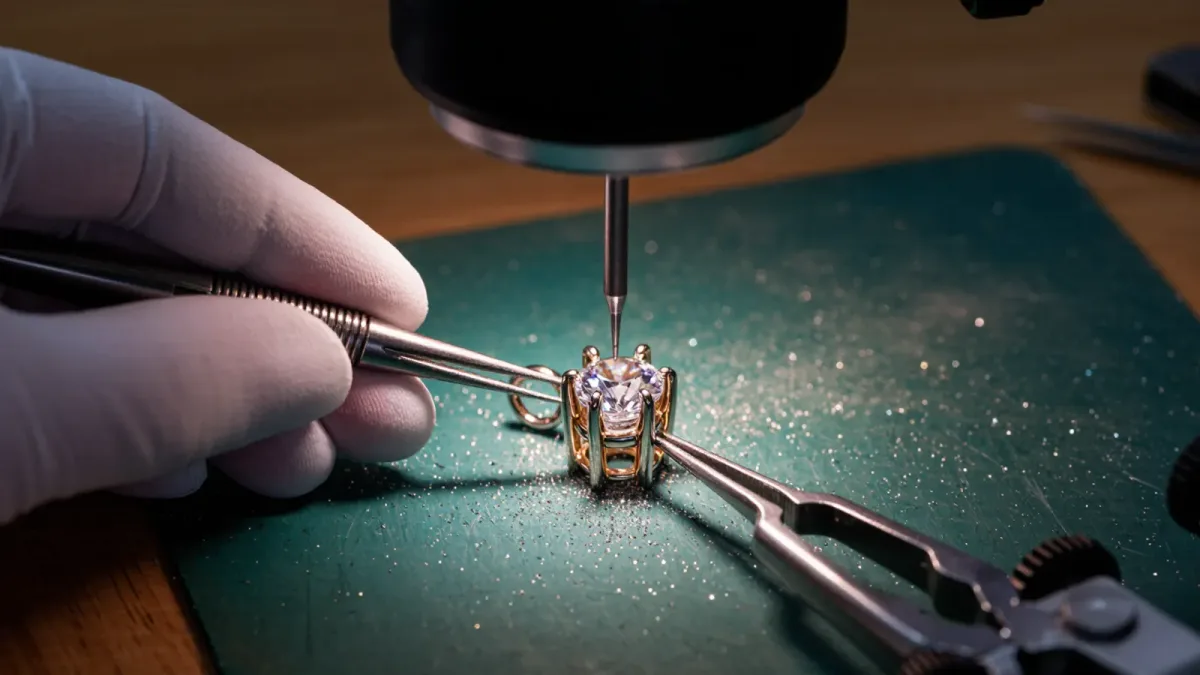
A single high jewelry necklace can absorb 1,000 to 3,000 hours of work and pass through the hands of six to ten specialists before it is finished. This is the tier above fine jewelry: one-of-one pieces, exceptional stones, and construction methods borrowed from mechanical engineering. The process explains the prices — and gives a buyer a concrete vocabulary for judging any jeweled object, from a five-figure pendant to an auction lot.
Above Magazine publishes information, not purchasing advice; process descriptions reflect industry practice current as of early 2026.
What comes first, the stone or the design?
The stone. In high jewelry, the designer works around what has been acquired, not the reverse. A design director receives a parcel of stones — a 20-carat Colombian emerald, a pair of matched Ceylon sapphires — and builds a composition that shows each stone at its best angle, called its face-up position. The gemologist has already mapped inclusions, color zoning and the axis along which the stone was cut. Every subsequent decision, including the metal color of the setting, serves the stone. Platinum, for instance, is preferred under diamonds precisely because its white does not tint them.
What does the gemologist actually check?
Before design begins, each significant stone is graded and documented: species and variety, origin indicators, treatment disclosure — heat in sapphires, oil in emeralds — and a mapping of inclusions that doubles as an identity fingerprint. For stones of consequence, independent laboratory certificates accompany the piece for life. This matters for a buyer beyond the first purchase: at resale, the paper trail is the difference between a documented stone and a story.
How is the piece actually built?
- Gouaché. The design is executed as a large-scale painting — gouache on paper — fixing proportions, stone positions and metal tones before any metal is touched.
- Wax and metal. The mounting begins as carved wax or, increasingly, a wax pattern milled from a 3D model, then cast in platinum or 18k gold.
- The troy of specialists. A founder casts, a polisher finishes, a setter seats stones, an engraver cuts details, a jeweler-solderer assembles articulated sections.
- Setting. In high jewelry, the setter often works directly on the finished stone's measurements — each seat is cut to that individual stone, not to a standard size. This is why replacing a lost stone in high jewelry is not a quick fix; the seat is unique.
- Finishing. Rhodium plating on white metal, hand polishing, and a final assembly where articulated links are balanced so the necklace drapes rather than stands.
Why do the hours matter to a buyer?
Because labor is the only input that cannot be faked at scale. A setting with cut-down pave — where each metal bead is raised from the piece's own metal and shaped over the stone — shows no seams and no casting porosity under a loupe. Cast look-alike settings show mold lines and rounded prongs. When you evaluate any jeweled piece, the speed test is simple: look at the underside. High jewelry is finished on the back and inside the galleries, because its makers assume someone will eventually look there.
Related stories: What Happens During 200 Hours of Finishing on a Mechanical Watch Movement · Inside the Maison Machine: How French Conglomerates Actually Run Luxury Brands.
How does articulation separate tiers?
A great high jewelry necklace drapes like fabric because its links are individually hinged, weighted and counter-balanced — work that happens after the stones are set, when the piece is tried on a neck form and adjusted link by link. Stiffer pieces from lower tiers achieve sparkle but sit like armor. The drape is engineering, not luck, and it can add hundreds of hours.
What about the diamonds' provenance?
Since the G7 restrictions on Russian diamonds tightened direct imports, stones above a threshold entering the US require documentation of origin, enforced at the border by US Customs and Border Protection (CBP, 2025). For a buyer, this has a practical consequence: ask for provenance documentation on any significant diamond. Legitimate houses produce it without hesitation; hesitation itself is the answer. Reuters reported through 2025 that the industry continued adapting to the traceability requirements (Reuters, 2025).
How do you buy your first significant piece?
The process knowledge translates into a buying order: stone first, construction second, name third. A well-cut, well-documented stone in a cleanly finished setting from a house you have not heard of will outlast and out-resell a mediocre stone under a famous marque, because the stone is the residual value and the setting is the labor that proves it was handled seriously. Insist on laboratory certificates for stones of consequence, on treatment disclosure in writing, and on seeing the underside and gallery before purchase. If the piece is intended to be worn for decades and eventually passed on, favor platinum or 18k in constructions that can be re-tipped and resized — the high jewelry virtues of individual stone seats and hand-finishing are exactly the virtues of repairability. And when a budget forces a choice, take the smaller stone in better construction: in this tier, unlike anywhere else in fashion, the best-made smaller thing is the one the next generation will thank you for.
One cost logic completes the picture. In high jewelry pricing, the stone typically anchors the value, but the labor premium is where houses differentiate — and where auction resale concentrates its verdicts. Two necklaces with comparable centers can differ threefold because one carries hand-executed anglage on its gallery, articulated draping rebuilt across fittings, and settings cut to each individual stone, while the other adapts standardized components. The market reads this fluently at resale: documented one-of-one commissions with atelier records retain value that catalog pieces from the same house do not. For the buyer, the actionable translation is to ask what is unique about the construction, not just the stone — houses answer precisely for pieces they are proud of, and the answer's specificity is itself a valuation tool you can carry into any vitrine.
The takeaway
When you next look at a jeweled piece — in a vitrine, at auction, or inherited in a drawer — ask three questions in order. Is the work finished where no one is supposed to look? Are the seats cut to individual stones? Does the piece move like textile or like metal? Three yeses indicate hundreds of specialist hours; the price conversation changes accordingly.