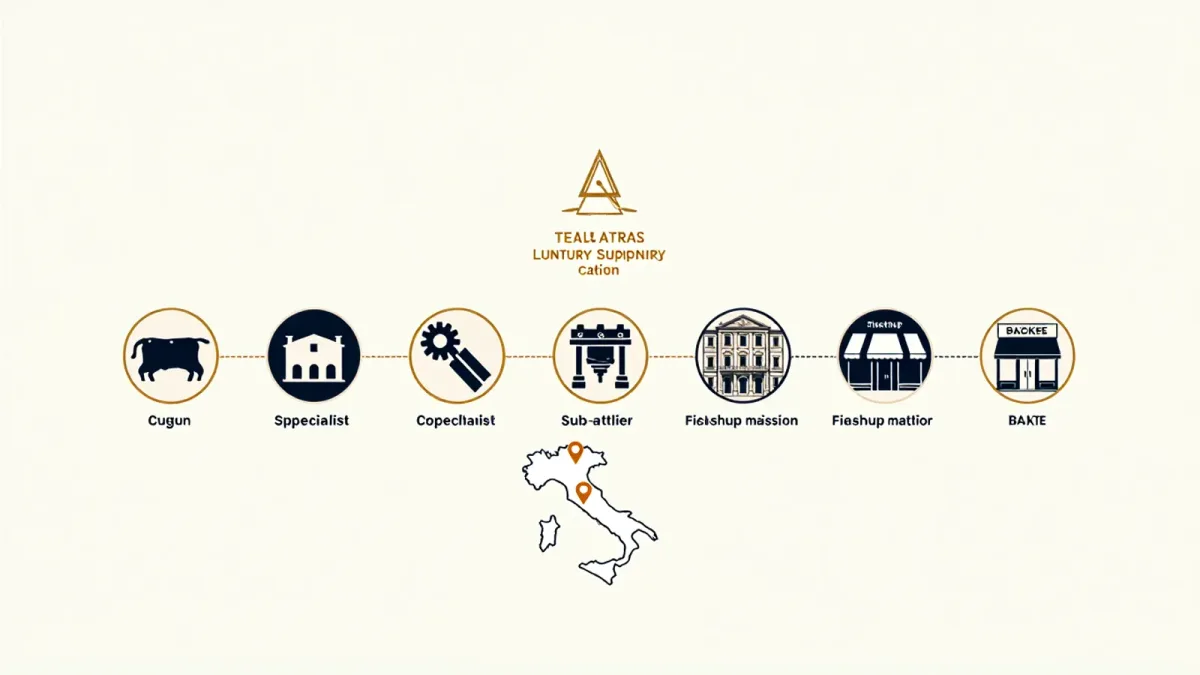
Italy supplies a majority of the leather goods, knitwear and footwear production behind European luxury's made-in labels, with the district system — clusters of specialized suppliers around towns like Florence's leather belt or Prato's textile mills — functioning as the industry's subcontracted factory floor. Understanding that system changes how you read a price tag: "Made in Italy" is not one workshop with masters at benches but a tiered network, and the stamp's value depends on which tier did the decisive work.
Above Magazine publishes information, not purchasing advice; supply-chain descriptions reflect district structure as reported through 2025-2026.
What is the Italian district system?
Luxury production in Italy is organized in industrial districts: geographic clusters where thousands of small, specialized firms make components and finished goods for the major houses. Tuscany's tanning districts around Santa Croce sull'Arno process vegetable-tanned leather for much of the luxury market; the Veneto and Marche regions dominate footwear; Como does silk printing; Prato runs wool and cashmere at enormous scale. Each firm is narrow — one may only do skiving, another only edge painting — and the house's own atelier sits at the top of this pyramid, doing final assembly, quality control and the highest-difficulty work. The district structure is centuries old, and its density of specialized skill is the reason the work cannot simply be relocated: the ecosystem, not any single factory, is the moat.
What do the tanneries actually contribute?
More than any other link, tanneries determine whether a leather good lasts. Tanning converts raw hide into stable material — vegetable tanning with tree-bark tannins takes weeks and produces leather that patinas and can be restitched for decades; chrome tanning takes a day and dominates volume production. Subsequent steps — splitting, retanning, dyeing, fatliquoring, finishing — each have artisanal and industrial versions, and the differences are invisible at purchase and decisive at year ten. This is why serious leather houses specify their tanneries by name, and why a bag's tannery provenance is a better quality signal than its logo.
How do the tiers affect what you pay?
Follow a bag through the chain: raw hides are bought at auction, tanned in Tuscany, cut by a component specialist, edge-painted by another, then assembled — either in the house's own atelier or in an approved sub-atelier. Labor at each tier is additive, and the house's audit tier matters: goods made entirely in-house command and receive pricing that reflects the margin of control. Reuters reporting through 2025-2026 has documented the sector's labor scrutiny — prosecutors investigating sub-tier suppliers for wage exploitation exposed the gap between the flagship narrative and the subcontracted reality (Reuters, 2026), pushing major houses to insource more production and publicize their audit programs. For buyers, the consequence is a new question worth asking: which tier made this?
Related stories: Hammer, Premium, Withdrawal: How the Auction Economy of Watches Really Works · Inside the Maison Machine: How French Conglomerates Actually Run Luxury Brands.
What does 'Made in Italy' legally mean?
Less than buyers assume. The label indicates where the product was manufactured — finalized — not that every input is Italian, and non-EU hides and components routinely flow into Italian-made goods. The EU's 2024 forced-labor regulation, banning products made with forced labor from the single market, is tightening enforcement upstream, and houses have responded by vertically integrating: acquiring tanneries and component firms to control what the label cannot. A house that owns its tannery can certify its chain; a house that buys at district spot prices relies on audits alone.
How should a buyer use this knowledge?
- Ask for the tannery and atelier tiers. Brands proud of their chain answer specifically; vague answers locate the product in the sub-tier the price pretends is elsewhere.
- Read the leather, not the stamp. Vegetable-tanned leather that scars and darkens honestly beats coated correction-grade leather whatever the label says.
- Weight the in-house premium. Paying more for fully in-house production is rational — you are buying the control tier that audits cannot fully replace.
What is the district system's real constraint?
People, and the generational pipeline behind them. The master workers who anchor the top districts are aging, vocational training pipelines produce fewer finishers than the maisons' expansion plans assume, and young Italian workers weigh artisan wages against service-sector alternatives — which is why houses have opened training schools attached to their new workshops, guaranteeing employment to graduates. Migration has quietly become part of the system's labor answer: district workshops increasingly employ trained workers from outside Europe, and the sector's labor scandals made formal, contracted employment both a legal necessity and a marketing asset. For a buyer, none of this is abstract: the capacity constraint is why flagship bags have waiting lists, why houses ration production across their own catalogs, and why a fully in-house piece carries the premium it does — you are paying, in part, for the small and finite population of hands that can make it. The districts survived four decades of globalization because the ecosystem is irreplaceable; its next test is whether the pipeline of hands is.
The knitwear and shoe districts extend the same logic beyond leather, and the map is worth carrying when you shop. Como's silk printworks run short runs for the maisons that volume mills cannot; Prato's recycling heritage — centuries of re-carding wool — makes it the unlikely center of both cashmere and circular knitwear; the Marche and Veneto shoe districts hold the pattern-makers and last-models that sneaker luxury is built on. What unites them is the component-level specialization: in each district the decisive skill is split across dozens of small firms, which is why the labels read made in Italy rather than made by, and why a house's real capability is measured by how many of those firms it has under contract or ownership. When a brand publishes its supplier map, count the Italian tiers — the depth of that list is a better quality proxy than any single atelier's name.
The takeaway
"Made in Italy" names a district system, not a workshop, and the stamp's honesty depends on how deep into the chain a house controls. The questions that locate value are the tannery's name, the assembly tier and the leather's finish — and the houses that answer them are, more often than not, the ones whose goods survive the decade the price implies.