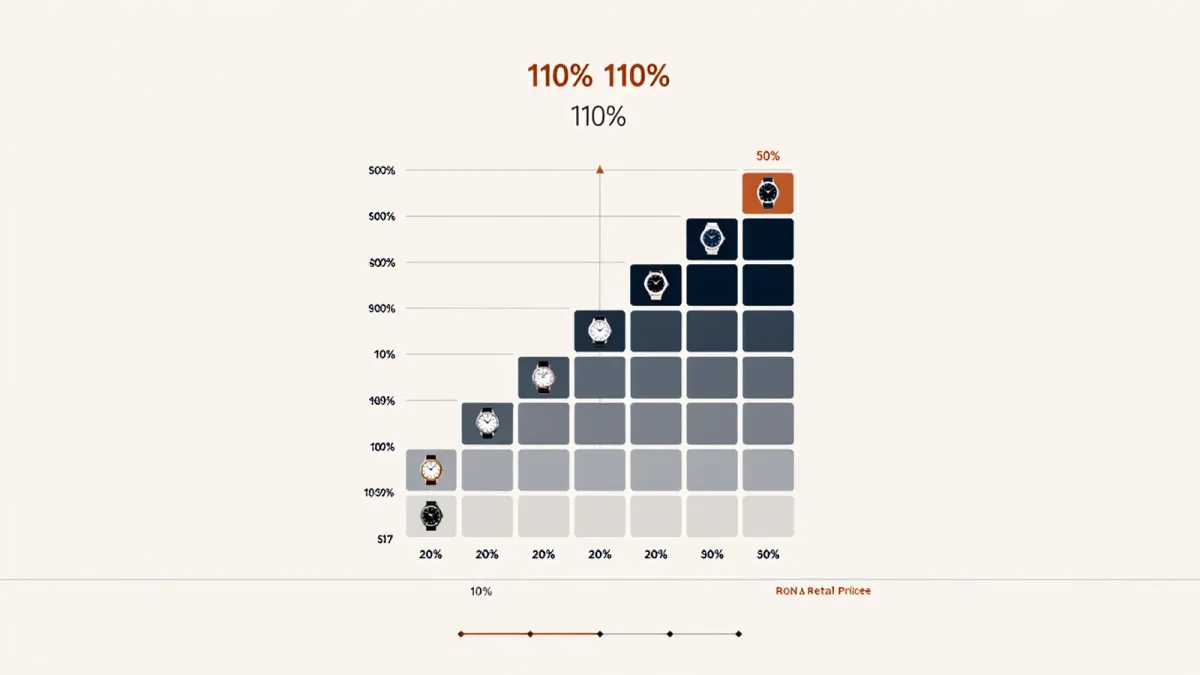
Only a small minority of watches sell above their original retail price on the secondary market — at the top of the ladder, a handful of references command premiums; in the middle, most watches transact at meaningful discounts to retail. The pattern is not random. Resale value follows identifiable mechanics: scarcity that is engineered rather than accidental, demand that spans decades, and transaction costs that quietly tax everything. Here is how the ladder is built.
Above Magazine publishes information, not investment advice; watch buying should start with wearability, and appreciation is a byproduct, not a plan.
Which brands sit at the top, and why?
One brand dominates the premium tier, with a small group of independent makers and a couple of integrated manufactures filling the next ranks. The common mechanics are more interesting than the names. First, production discipline: the strongest value-retaining references are chronically under-supplied relative to documented demand, and that shortage is managed, not accidental. Second, reference continuity: models produced with the same designation for decades accumulate history that supports both provenance and service networks. Third, breadth of collector base: a reference that two generations of collectors agree is canonical transacts faster and tighter than an equally good watch without the consensus.
What discounts the middle of the market?
Most fashion-adjacent and volume luxury watches lose 30 to 50 percent of retail on day one of secondary ownership, for structural reasons. Retail prices carry brand marketing and boutique margins that the secondary market will not pay. Production volumes erase scarcity. And fashion-driven references — limited to a campaign cycle — lack the collector consensus that carries value across decades. None of this makes them bad watches; it makes them purchases, not stores of value, and pricing a watch purchase that way is the honest starting point.
How much do transaction costs matter?
Massively, and they are the most ignored number in watch buying. Selling through consignment or a dealer typically costs 10 to 20 percent; buying at retail included tax; buyer's premiums at auction add up to around 25 percent on the first tranche. A watch must appreciate 30 percent or more before its owner breaks even on a round trip. Per Reuters coverage through 2025, secondary-market price indexes for the most-traded references corrected sharply from their 2022 peaks before stabilizing (Reuters, 2025) — a demonstration of why transaction costs, not headlines, decide the outcome for ordinary owners.
What preserves value at the individual-watch level?
- Box and papers. A complete set routinely adds double-digit percentages; missing papers discount more than missing links.
- Service history through authorized channels. A stamped service record converts a watch from a story into a file.
- Original, unaltered condition. Unpolished cases with sharp edges, original dials and hands — refinished dials and over-polished cases are the two largest value destroyers in vintage pieces.
- Condition of the bracelet. Stretch, replaced links and aftermarket clasps are inspected first because they are the easiest to spot.
Related stories: Hammer, Premium, Withdrawal: How the Auction Economy of Watches Really Works · Quiet Luxury: Why the Most Expensive Things Stopped Announcing Themselves.
Does a complication help or hurt value?
Depends on the complication's demand breadth. A chronograph from a canonical maker has the deepest collector pool; a boutique-only limited edition of a niche complication has the narrowest. The market rewards complications that many collectors want, not the ones that are hardest to make. A hand-finished time-only piece from a top-tier house outperforms a mass-finished annual calendar from a mid-tier one — labor and consensus, in that order, drive the ladder.
How should condition documentation be built from day one?
Value preservation starts at purchase, not at sale. Keep the box, warranty card, purchase receipt and any service paperwork in one file — the complete set routinely adds double-digit percentages at resale, and assembled years later it cannot be reconstructed. Photographs at purchase establish a provenance trail that matters increasingly as the secondary market professionalizes. Schedule service by the manufacture's intervals at authorized centers and keep the stamps; an undocumented movement, however honest, sells as a story rather than a file. Resist customization: engraving, aftermarket diamonds and swapped bracelets each subtract from the pool of buyers willing to pay full tiers — the market pays for the reference as the manufacture made it. And handle the case as a collector does: polishing removes metal, and a case polished flat of its bevels has permanently surrendered its sharpness. The paradox of watch care is that the best-preserved watches look barely worn — which is exactly what the condition premium pays for.
A note on timing, since the secondary market breathes: prices in the tradable references move in visible cycles, and buyers who purchase at retail during a hype phase absorb the correction that follows, while those who buy after one hold basis advantages that no brand loyalty replicates. None of this requires day-trading. The working rule is contrarian patience: buy the reference you would wear regardless, at the point in the cycle when dealers are discounting rather than waitlisting it, and judge the purchase on a five-year horizon. Watches bought this way rarely become losses; watches bought at the peak of someone else's enthusiasm frequently do — and the difference between the two outcomes was decided the day of purchase, not the day of sale.
The takeaway
Run the three-question screen before any watch purchase: is this reference produced in disciplined scarcity, does it have decades of demand consensus, and would its condition be easy to document? Two yeses make a durable purchase; three make a candidate for the top of the ladder. And if the honest answer is no to all three, buy the watch to wear it — which was always the point — and let someone else's spreadsheet fund the premium tier.