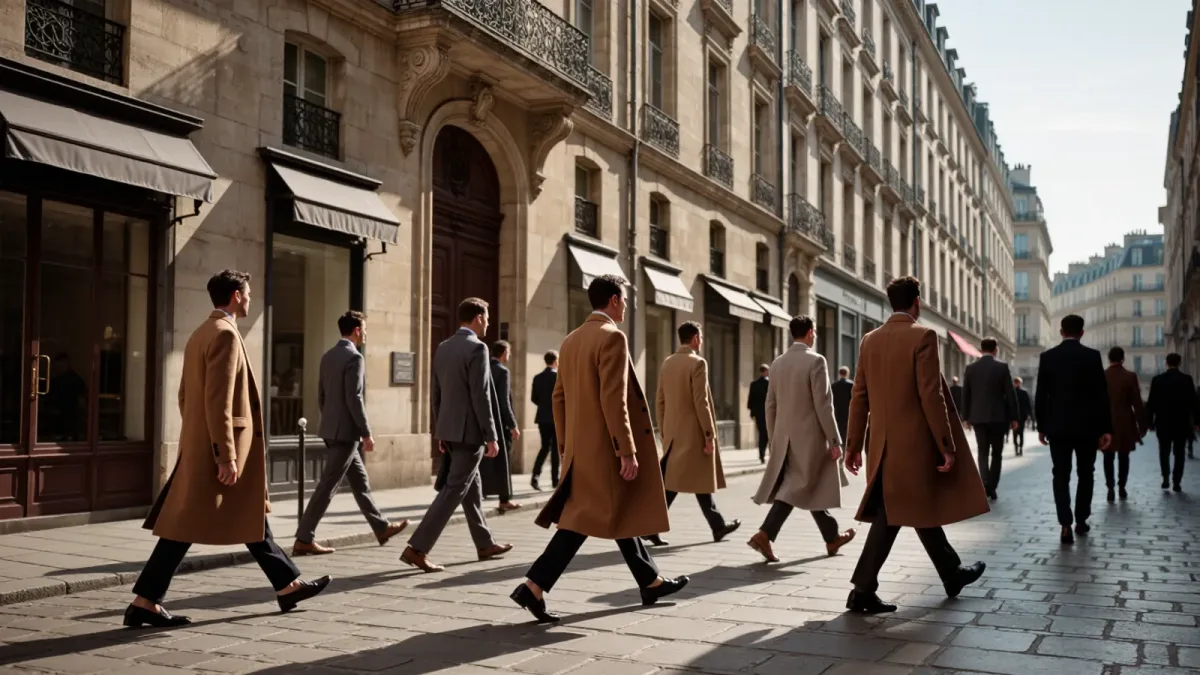
Walk through a room of people who spend serious money on clothes and the person most expensively dressed is often the one you cannot price. That is quiet luxury in practice: garments whose status signals live in fabric weight, cut and finishing rather than logos. The phenomenon is not new — the Italian term sprezzatura and old-money codes predate it by centuries — but its current dominance is structural, and understanding the mechanics matters more to a buyer than the aesthetic.
Above Magazine publishes information, not purchasing advice; this analysis draws on industry reporting current as of mid-2026.
Why did logos peak and recede?
Three forces converged. First, democratization inverted the signal: when monograms became accessible through outlet channels, entry-price lines and counterfeits, the logo stopped certifying wealth — anyone could wear it, so the wealthy moved upmarket to signals that cannot be copied cheaply. Second, a decade of logo-maximalism exhausted itself stylistically; trend cycles in fashion operate on reversal, and maximal logos were due. Third, and least discussed, resale mathematics: logo-heavy pieces are saturated with fashion-cycle risk, while quiet pieces — a camel coat, a leather tote without insignia — hold secondhand value because they do not date. Per Reuters coverage through 2025-2026, brands that built their business on visible monograms faced corrections as their aspirational customers traded toward stealth alternatives (Reuters, 2026).
What television did to the aesthetic
The 2023-2024 run of prestige television centered on old-money families — Succession's final seasons chief among them — turned understated dress codes into searchable, purchasable content. Sales of loafers, quiet wool tailoring and understated knitwear rose measurably in the seasons after, per retailer reporting widely picked up by the business press. The irony is structural: a stealth aesthetic that becomes a trend is no longer stealth. But the codes it popularized — neutral palettes, natural fibers, concealed branding — had the durability to survive the trend cycle that discovered them, because they were never invented for television.
What are the actual signals of quiet luxury?
- Fabric first. High-twist wool that resists wrinkling, cashmere with long staple and dense knit, vegetable-tanned leather that patinas rather than peels. Fabric cost is the quiet luxury budget's biggest line; logos cost nothing to weave into a jacquard.
- Cut. Shoulders that sit on the wearer's skeleton, trousers with a clean break, sleeves the right length. Tailoring is a service cost that logos never require — which is why it is the harder signal to fake.
- Construction visibility. Hand-finished buttonholes, functioning cuffs, patterns matched across seams. These reward close inspection, not photographs — a signal designed for rooms, not feeds.
- Restraint in hardware. Unbranded zippers, plain buckles, minimal metal. Where loud luxury plates its name onto hardware, quiet luxury removes the hardware's chance to speak.
Related stories: Which Watches Hold Their Value? The Resale Mechanics Behind the Ladder · Hammer, Premium, Withdrawal: How the Auction Economy of Watches Really Works.
Does quiet luxury just mean more expensive basics?
Often, and this is the buyer's trap: the aesthetic's popularity gave mid-market brands license to sell plain garments at stealth prices. A plain sweater is not quiet luxury; a plain sweater in traceable, long-staple cashmere with dense construction is. The difference is measurable — grams per knit, staple length, country of finishing — which is why the useful habit is reading labels and hand-feel rather than reacting to absence of logos. Absence of branding is the cheapest thing in fashion to counterfeit; quality is the most expensive.
How should a buyer use the trend?
Buy the codes, skip the marketing premium. The quiet-luxury wardrobe that survives a decade is built from: one tailored wool coat in a natural color, one leather bag without visible branding, tailoring that fits your actual shoulders, and knitwear in natural fiber you can have repaired. Check resale listings for the pieces you are considering — quiet references hold value precisely because they do not date — and prioritize makers whose plain pieces share production with their couture, because that is where the fabric budget actually goes.
Where does quiet luxury go when the trend fades?
The aesthetic's popularity will cycle, as all aesthetics do — runway collections have already re-amplified logos in alternating seasons — but the underlying allocation of spend is likelier to persist, because it tracks demographics rather than television. Two forces outlast the trend. Wealth transfer: the largest intergenerational asset transfer in history is underway, and its inheritors are fluently secondhand-native and logo-skeptical, spending on condition and provenance rather than signage. And the resale data loop: quiet pieces hold secondary value, holders notice, and the observation self-reinforces. The realistic forecast is a stable dual market — logo products for the aspirational transaction, quiet construction for the wealth that has nothing to prove — with brands increasingly running both registers under one roof. For the buyer, the lesson of the cycle is not to chase the aesthetic but to bank the checklist it popularized: fabric, cut, finishing, repairability. Those four survive every trend swing; that is precisely what quiet luxury was always about.
A practical note on where to spend within the aesthetic, because the codes differ in how efficiently they signal. Fabric and fit do the quiet work in motion — drape, shoulder line, trouser break — while finishing details reward proximity, and hardware restraint mostly prevents mistakes. Budget accordingly: tailoring alterations and quality cloth repay every euro; luxury-priced plain T-shirts repay almost nothing, since the signal lives in construction that a basic lacks but nobody sees at distance either. The wardrobe that emerges is unphotogenic by design — which is the point. Its verification lives in rooms: the hand that checks a cuff, the eye that reads a lapel seam, the colleague who asks where the jacket was cut. If you need the signal to work on a screen, this is not your register; if you need it to work across a dinner table for a decade, spend on cloth and cut and let the logos go to whoever still needs them.
The takeaway
Quiet luxury is best understood as a market correction, not a mood: signals migrated from logos to construction because construction is harder to copy and holds value longer. Shop accordingly — by fabric, cut and finishing, in that order — and the aesthetic outlives the television that made it searchable.