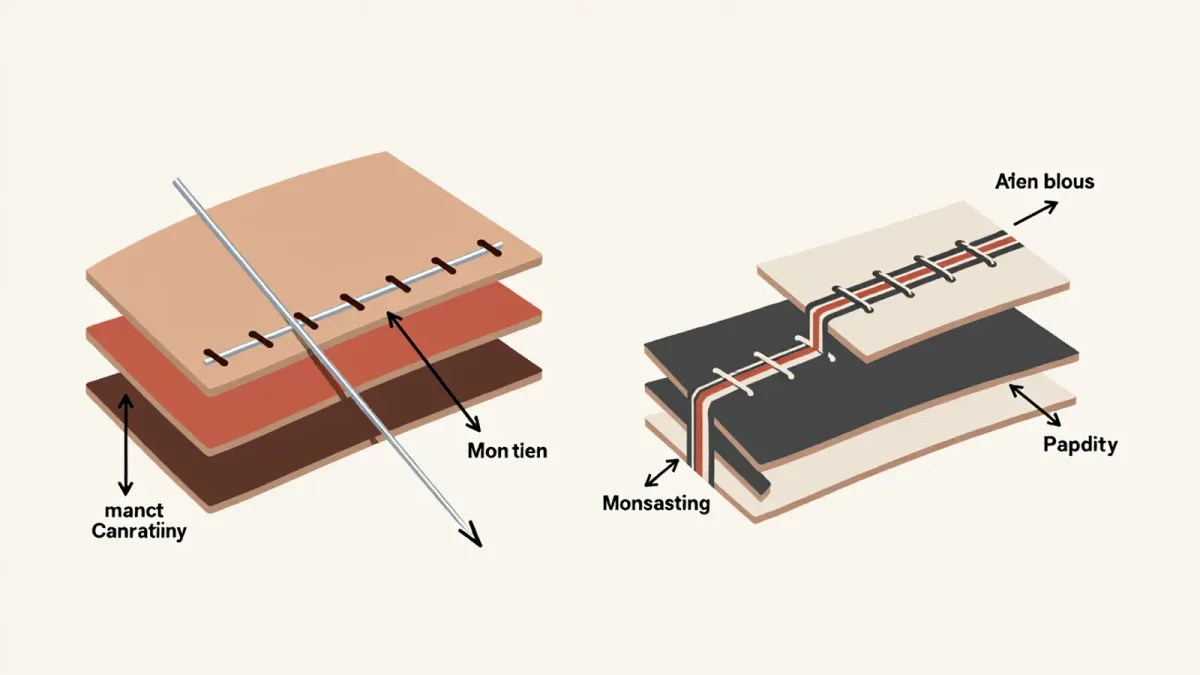
A single artisan can place roughly three to four saddle stitches per minute, and a hand-stitched bag carries thousands of them. The seam is the oldest joinery in leatherwork — unchanged in principle since saddlers built tack for working horses — and it remains the single most reliable way to read whether a leather good was made by a person or a production line. It is also the reason one bag can be resoled and restitched for twenty years while another fails at the strap within two.
Above Magazine publishes information, not purchasing advice; prices and practices described reflect industry sources current as of early 2026.
How does a saddle stitch actually work?
The saddle stitch uses one continuous length of thread with a needle at each end. The artisan passes both needles through a single hole from opposite sides, crossing the thread inside the leather, then moves to the next hole pierced by an awl. Because the thread crosses inside the material at every hole, the seam cannot unravel if one stitch is cut — it merely loosens locally. A lockstitch sewing machine, by contrast, holds each stitch with a tiny loop underneath; cut one and the seam can progressively fail along its length.
Why does the seam survive when machine stitching fails?
Three mechanical reasons. First, thread tension: a hand stitcher controls tension stitch by stitch, so the seam flexes with the leather instead of fighting it. Second, thread type: saddle stitching typically uses polyester or linen thread that is hand-waxed, thicker in cross-section than machine thread, and seated into the stitching groove or slightly recessed crease so it wears below the surface rather than above it. Third, hole preparation: the awl or pricking iron pierces rather than punches, displacing fibers so they close around the thread, instead of a machine needle cutting a hole through them.
What should you look for when buying?
Turn the bag over and read the seam like a text.
- Slant and rhythm. A saddle stitch leans consistently at roughly a 45-degree angle, alternating side to side. Perfectly uniform vertical stitches in a machined rhythm indicate a lockstitch machine.
- The back side. Hand stitching shows a slightly different stitch pattern on the reverse — the same slant, offset — because it is two needles working one line. Identical front and back with machine regularity means machine.
- Thread termination. Hand stitchers finish by backstitching into the seam and trimming; look for a discreet doubled section near the strap anchor points.
- Where it counts. Many production bags are machine-sewn on panels but hand-stitched on handles and stress points, which is a legitimate hybrid — the pricing should reflect it.
Related stories: Inside the Maison Machine: How French Conglomerates Actually Run Luxury Brands · What Happens During 200 Hours of Finishing on a Mechanical Watch Movement.
How much does hand stitching add to cost?
Labor dominates. At even four stitches a minute, a tote with 1,500 stitches represents the better part of a working day for the seam alone, before cutting, edge finishing and assembly. This is why the top tier of French and Italian leather houses prices hand-stitched pieces at multiples of their machine-sewn equivalents, and why ateliers guard stitch counts in product specifications. Reuters reported through 2025 that luxury houses were steadily expanding leathergoods ateliers in France and Italy to secure exactly this kind of skilled labor (Reuters, 2025) — the constraint is not demand, it is people who can hold the tension.
Is a saddle stitch always better?
Not universally. For straight, flat, high-volume construction, a well-tuned lockstitch machine produces a strong, consistent seam that outlasts the leather around it. The saddle stitch wins where seams curve, where stress concentrates — handles, gussets, strap roots — and where future repair matters, because a hand seam can be unstitched and redone section by section. The honest specification is a mix: machines for panels, hands for everything that carries weight.
Does waxed thread matter?
More than most buyers think. Hand-waxed thread resists rot, seats into the groove without sawing, and holds its knot. Waxed linen is the traditional choice and patinas with the leather; modern polyester waxed thread is stronger and unaffected by water. Either is acceptable — an unwaxed, thin, glossy thread is the tell of decoration rather than engineering.
How do repair and restitching work on a hand-sewn bag?
The saddle stitch's repair advantage shows its worth at year ten. Because each stitch is independent and the thread runs in one continuous line, a damaged section can be unstitched locally, the leather cleaned and re-waxed, and the seam re-sewn by hand without disturbing the rest — a bench operation any competent leather repairer can quote on sight. Machine lockstitch seams are harder to repair invisibly: the needle holes from the original run puncture and weaken the leather, and a re-sewn machine seam on worn holes tends to look like exactly what it is. This repairability is a financial property, not just a sentimental one: a hand-stitched handle or strap root re-sewn for a modest sum extends a bag whose replacement price has inflated since purchase, and documented repair history strengthens resale. When buying, this is the last question for a maker: can this seam be re-sewn by anyone, or only by you? A construction that requires its original atelier for a strap repair was not built for decades; it was built for the warranty period.
The takeaway
Ask where a bag is hand-stitched, not whether. A maker who can answer — handles, gussets, strap anchors — has made the decisions that determine a twenty-year object. A maker who answers "handmade" without pointing to a seam is selling you a story the stitching cannot verify.