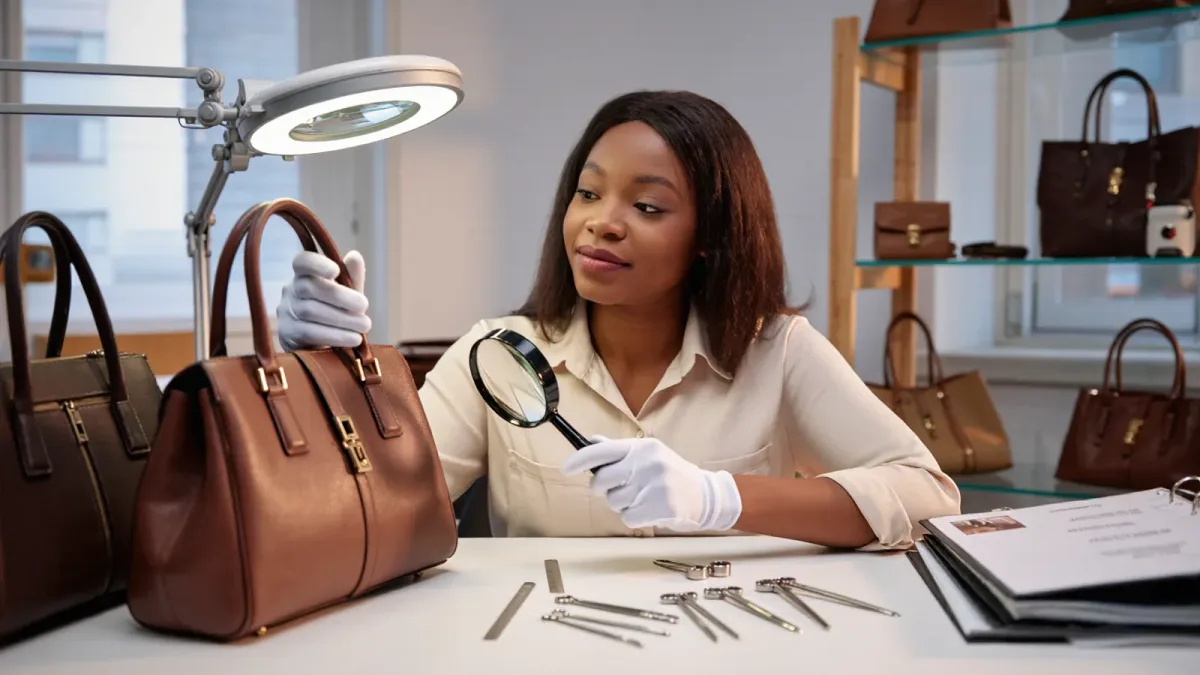
Customs seizures of counterfeit goods entering the United States were valued at more than $2 billion at manufacturer's suggested retail price in recent fiscal years, and handbags consistently rank among the top seized categories per US Customs and Border Protection data (CBP, 2025). The secondhand market's growth has raised the stakes: a fake that once fooled a tourist now has to fool a resale platform. This guide is ordered the way professional authenticators work — cheapest and most revealing checks first.
Above Magazine publishes information, not purchasing advice; authentication here means careful verification, not certification. When real money is involved, a documented third-party authentication service is worth its fee.
Check 1: The seller, before the bag
Most bad purchases are seller problems, not bag problems. Ask: Does the seller own the item and can they show provenance — original receipt, card, dust bag with consistent style? Do they accept third-party authentication as a condition of sale and a return window? Is the price only slightly below retail for a bag that never discounts — the classic too-good signature? A seller who resists verification has answered your question.
Check 2: Stitch count and stitch quality
Count stitches per inch on a handle or flap edge — roughly ten per inch is the benchmark on major French houses' handbag lines, and more telling than the number is the regularity: consistent length, spacing and tension, with no thread ends or double rows where one line should run. Machine-perfected regularity is itself the houses' standard; irregular, frayed or glossy thin thread disqualifies a bag at this stage more often than any other single check.
Check 3: Heat stamps and engravings
The brand stamp carries a full typography lesson: letter spacing, serif shapes, depth of foil, alignment with stitch lines. On many models, the stamp sits inside a leather frame patch of exact dimensions — counterfeiters routinely get the font close but the kerning, foil saturation or patch proportions wrong. Compare against a verified example of the same year and model, because houses have changed stamp formats across decades; a stamp copied from a different era is a timestamp error, one of the most reliable tells there is.
Check 4: Hardware weight and finish
Zipper pulls, clasps and feet should feel dense for their size — the major houses use solid brass with plating, and the weight is hard to fake cheaply. Run a finger over engraving on hardware: authentic marks are crisp, evenly deep, with clean channels. Check zipper tape color continuity with the leather, and whether the zipper runs smoothly without a loose, rattling pull. Heat-stamped date codes or microchip serials (several houses transitioned to chips in the 2020s) should be consistent with the bag's claimed production year.
Related stories: Which Watches Hold Their Value? The Resale Mechanics Behind the Ladder · Buying Vintage Jewelry: A Boots-on Service Guide to Eras, Marks and Fair Prices.
Check 5: Leather, lining, smell
House leather has specific grain: coated canvas should have a particular texture and pattern symmetry, tanned calfskin a distinctive smell — chemical, sharp, or glue-like odor is the cheapest fake's confession. The lining should be cut in one direction with the pattern centered and symmetrical; misaligned monogram or crooked panel joins fail here. Interior pockets, zippers and heat-stamped care labels follow the same logic as exteriors but receive less counterfeiter attention — the inside is where the corners were cut.
Check 6: Documents, digital era included
Receipts can be generated, so weight documents last, not first. Modern verification increasingly includes NFC chips or serial databases some houses introduced, plus third-party services that issue certificates with photographic records. Per Reuters coverage through 2025, resale platforms have been tightening their authentication standards as regulators and lawsuits scrutinize verification claims (Reuters, 2025) — meaning the certificate now carries legal weight, not just reassurance.
What about super fakes and dealer-grade replicas?
The top tier of counterfeit production has narrowed the gap on specific checks: stitch counts can be matched, hardware can be cast heavy, and fonts can be traced from genuine examples. What remains structurally difficult is consistency across all six checks at once — the replica that nails the stitching may still miss the lining pattern alignment or the date-code logic for the claimed production year. This is why professional authentication always runs the full sequence rather than any single test, and why the era-consistency check has grown in importance: a stamp format, hardware finish and lining fabric must all agree with the same production window. A genuine bag was made in one factory in one year; a replica is an assembly of best-effort parts. When the parts disagree about when and where the bag was born, the bag is lying.
A word on where authentication fails, because honest limits matter in a service guide. Physical inspection catches construction fakes, but it is weakest against the gray zone: factory overruns, assembled-from-genuine-parts hybrids, and bags serviced with non-original components — all real, all technically complicated to classify. This is why the strongest verification combines the physical checklist with provenance: a purchase history, service records from the house, and consistent photographs over years. It is also why payment method matters — buyer-protection channels exist precisely because even experts disagree at the margins. The practical policy: never let enthusiasm compress the sequence. The six checks take twenty minutes; a counterfeit purchase costs the full price and, on many platforms, the recourse. And when the checks pass but something still feels off, that instinct is data too — the secondhand market offers more bags every week, and the one that requires rationalizing is the one to leave on the table.
The takeaway
Run the six checks in order and you will catch the overwhelming majority of counterfeits before money moves — and when any single check fails, walk away, because authentic bags fail none of them. For purchases above four figures, add the professional layer: a third-party authentication with documentation, and payment methods that carry buyer protection. The bag that cannot survive scrutiny was never the right price.