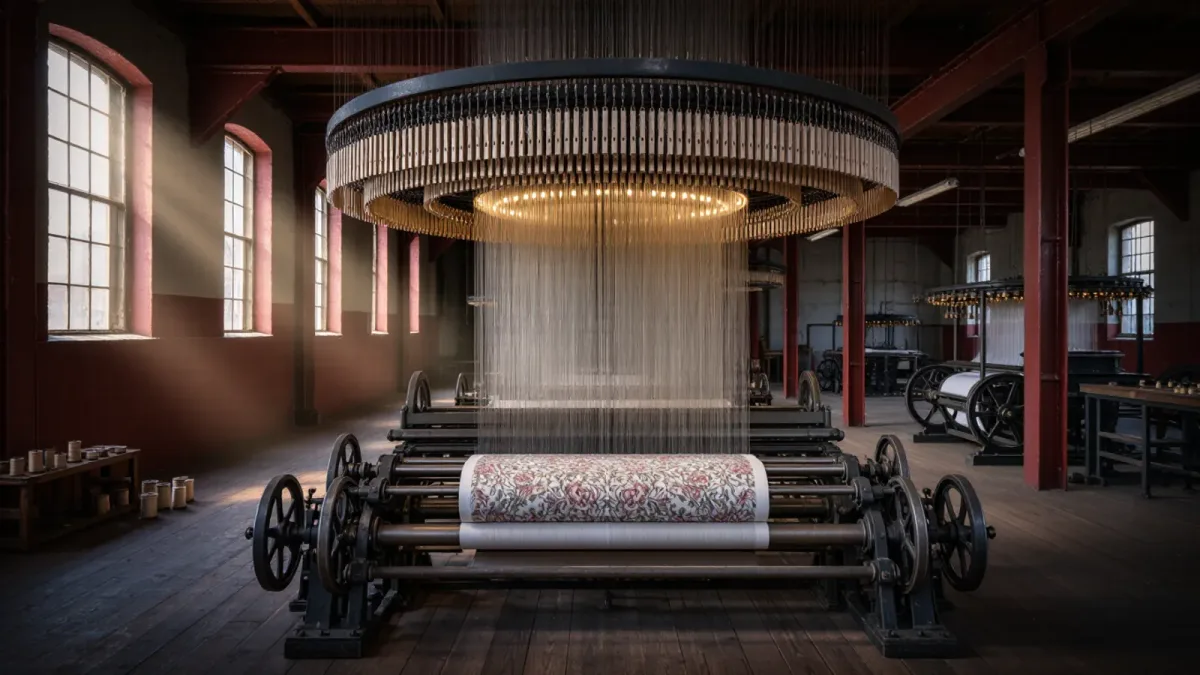
A jacquard loom weaves pattern by controlling each warp thread individually, which means the design must exist as a code before a single shuttle moves. The principle dates to Joseph Marie Jacquard's 1804 loom in Lyon, which read punched cards — one card per weft pass, one hole per raised warp — making it, functionally, the first programmable machine in mass use.
That is why jacquard fabric carries a different kind of price than printed cloth: the pattern is not applied to the fabric, it is the fabric's own structure. Reverse the cloth and the motif persists, mirrored. Print a flower on twill and scratch it; weave it into jacquard and it lasts the life of the textile.
From punched card to digital file
The modern pipeline keeps the old logic. A designer's artwork is reduced to a point map — every intersection of warp and weft assigned a lift or no-lift instruction, often across eight or more warp layers for a multicolored, dimensional cloth. Where 1804's cards marched in chains, today's electronic jacquard heads read digital files and can raise thousands of cords independently. Lyon's silk mills, the cradle of the technique, still encode couture brocades this way; the Library of Congress holds extensive documentation of the punched-card era that later inspired early computing.
- Repeat size is a cost driver: larger, non-repeating motifs need more codes and slower weaving.
- Color count behaves differently than in printing — each color needs its own warp or weft, not a screen.
- Matelassé, brocade and damask are all jacquard-family structures, distinguished by how raised the motif sits.
Why jacquard shows up in fall collections
Jacquard reads as autumn weight: dense, self-patterned cloth that holds an A-line or a cocoon coat without heavy interfacing. When a season's runways fill with woven florals and baroque upholstery-like brocades, that is a jacquard cycle — mills book months ahead, and the lead time is real: a new couture brocade can take weeks of coding and sampling before the first meter is sellable.
Related stories: Donegal Tweed: The Colored Knots That No Machine Pattern Predicts · Why Your Spring Colors Were Chosen Two Years Before You Saw Them.
How to judge a jacquard in a store
Turn it over. In a true woven jacquard the design shows on the reverse, in floats or mirror image. Feel the hand: cheap jacquards use long floats that snag on rings and bag at the elbow. Check the repeat alignment at seams — matching a large motif across a pocket or princess seam costs cutting time, and its absence signals where the garment was value-engineered. Stretch the cloth slightly; a firm, elastic-less weave that springs back is a densely set loom, and it will wear far longer.
Reading a jacquard label like a mill insider
Garment labels help more than shoppers expect. "Jacquard weave" means the motif is structural; "jacquard knit" means the pattern is knitted in on a flat or circular knitting machine — softer, stretchier, and cheaper, with less definition on fine motifs. Composition matters with the structure: wool and cotton jacquards press beautifully and resist snagging; viscose-rich versions drape heavily but pill at friction points; silk jacquard, the couture standard, combines both virtues at the highest price. Weight per meter is the last decoder: upholstery-weight brocades above 400 g/m hold sculptural coats on their own, while 200 g/m jacquards need interfacing to keep a shape, which is where cheap versions go stiff. Mills in Lyon, Como and the English worsted towns each carry registries of patterns going back a century, and houses commissioning new cloth pay for the coding work even when the loom is electronic — the design program, not the machine time, is where a signature jacquard's development budget goes.
The takeaway
Jacquard is pattern as architecture, not decoration. Reverse, snag-test, and check seam alignment — three moves that tell you whether a woven coat's premium is in the loom or only on the label.