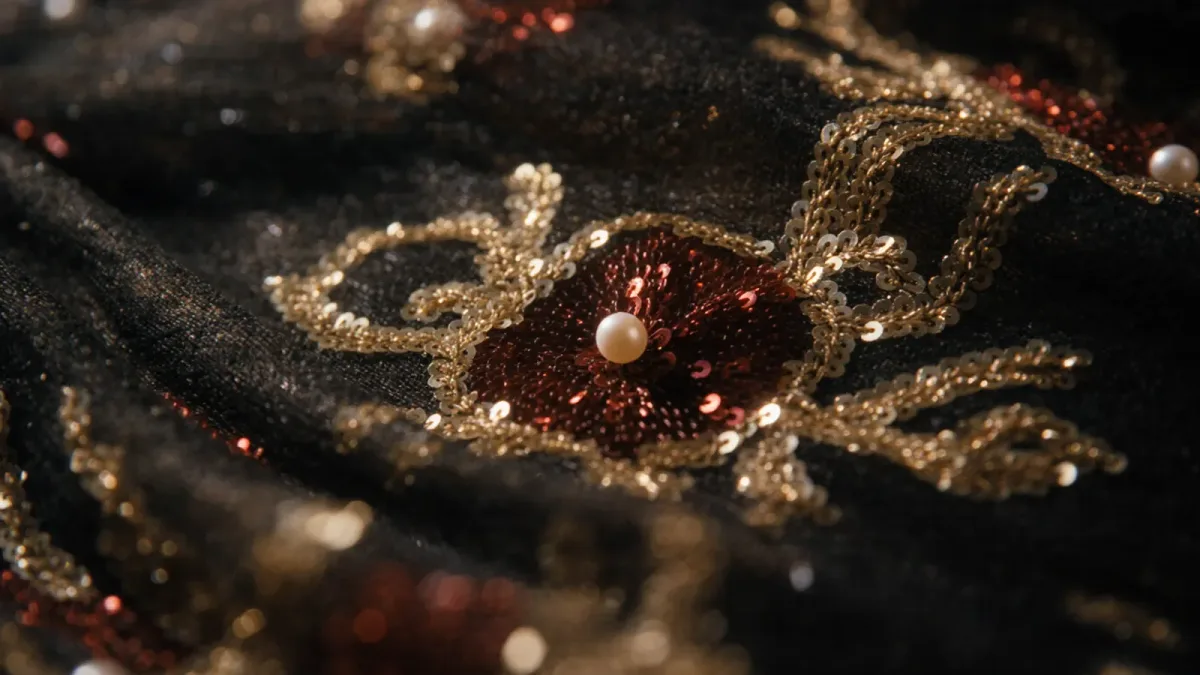
Couture embroidery is priced by hours and materials, not by size. A densely embellished gown can occupy one embroiderer for 300 hours; heavy paillette and crystal compositions on a wedding-scale piece can run past 1,000. At Paris atelier labor rates, that frame time alone puts the decoration into five figures before the base garment, the crystals or the design studio's cut are counted.
The discipline's center of gravity is a handful of specialist ateliers — the Paris embroiderers acquired under the maison-owned métier umbrella alongside feather-workers and goldsmiths — whose sample books ("abécédaires") sell a design language, then execute it by hand frame or machine frame depending on the couture brief.
How a motif becomes a price
The process starts with a design drawing, translated into a full-size outline on perforated paper that is pounced onto the tulle base. Then the math: every element carries a rate — so many minutes per sequin sewn flat, more if it is cupped, more again with a crystal at center; bullion and pearl work run slower still. Ateliers quote per element density, and a designer who changes the palette after sampling re-opens the quote, because dye-matched sequins are made to order in minimum runs.
- Lunéville hook (the tambour needle) is the speed tool for beads and sequins on tulle — years to master, dramatically faster than needle-and-thread for dense areas.
- Motif scaling is nonlinear: doubling a medallion's diameter roughly triples the fill area, and the hours follow.
- Weight is an engineering constraint — heavy beading needs the bodice's foundation to be built like corsetry, adding tailoring hours behind the embroidery hours.
Machine embroidery vs hand: what the premium buys
Computerized embroidery produces remarkable density at a fraction of the cost, and most ready-to-wear "embellishment" is exactly that. The differences are mechanical: hand frame work lets the embroiderer modulate tension and direction organically, place each element to the body's movement, and combine materials mid-line — sequins flowing into feathers into cord without a visible program seam. Machine work repeats with perfect regularity, which under a loupe is the tell.
Related stories: Couture vs Ready-to-Wear: What Actually Changes When the Price Does · Why Your Spring Colors Were Chosen Two Years Before You Saw Them.
How to read embellishment in any store
Turn the fabric over. Hand embroidery's reverse shows thread paths managed with economy and knots placed off-line; machine embroidery shows a uniform, digitized back and often a stiffening backing fused to the base. Bend the fabric — hand-set beads move with the drape, machine panels resist it. And check density at the seam allowances: quality work is anchored so trim does not unravel where panels join.
The sample book economy
Embroidery ateliers sell twice: first through their abécédaires — the reference books of worked samples that studios consult like libraries — and only then through commissions. A sample in the book is a business card in thread: it demonstrates the atelier's technique range and becomes the starting point a designer modifies. Commissioning from a book entry is faster and cheaper than inventing from zero, which is why signature techniques recur across houses in a season with per-house variations in color and density. The ateliers under maison ownership carry an implicit guarantee of survival — the houses fund them through thin couture cycles because the techniques cannot be rehired once dispersed, and each atelier keeps apprentices in the rare skills: the Lunéville hook, ostrich feather cutting, goldwork bullion. For the buyer, this structure explains an otherwise odd price fact: two gowns of identical silhouette can differ by a factor of ten in price purely on decoration, because the expensive one bought hours of specialized hand work that no machine currently replicates at comparable quality.
The takeaway
Embroidery pricing is legible: hours at the frame, elements per hour, materials to order. The upshot for buyers is simple — real hand embellishment justifies its premium and survives decades; its imitations are machine-made and should be machine-priced.