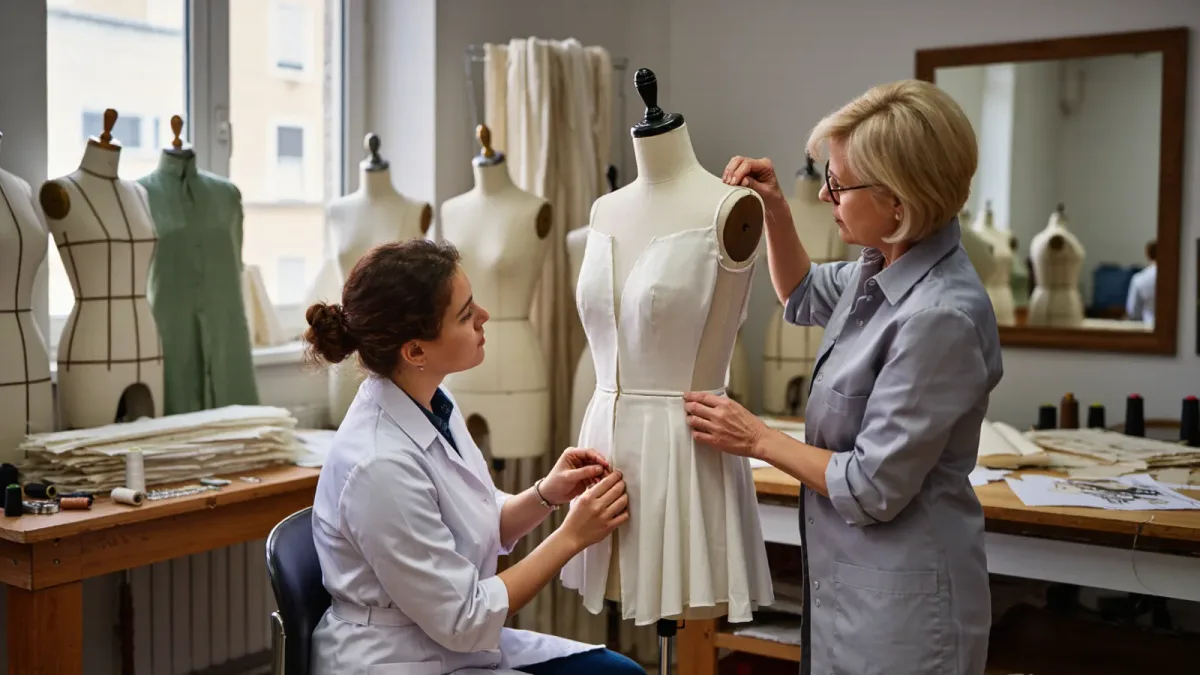
Haute couture is legally protected in France, and the bar is written into the rules: made-to-measure for a private client, with a significant share of work done by hand in the house's Paris workshops. Ready-to-wear — even the expensive kind shown at Paris Fashion Week — is industrial clothing designed in multiples. The distance between them is measured less in fabric than in hours: a beaded couture gown can absorb several hundred hours of specialist labor before it is ever worn.
This guide explains what that labor actually buys. Above Magazine publishes information, not purchasing advice — but knowing where the hours go is the fastest way to judge whether any garment, at any price, is built to last.
Who decides what counts as couture?
In France, the term haute couture is protected by law and controlled by the Fédération de la Haute Couture et de la Mode. A house must maintain a Paris atelier with full-time staff — the current framework expects dozens of technical employees split between tailored garments (flou is the dress side; tailleur is the suited side) — and present a collection of made-to-measure pieces each season. The January 2026 couture calendar carried roughly thirty shows, which tells you how small the club remains: most houses showing during Paris Fashion Week could never qualify, and most never try.
How the garment itself is built differently
A couture piece starts with a toile — a test version cut in inexpensive cotton muslin — fitted directly on the client or a stand, sometimes through four or five iterations. Pattern pieces are drafted to one body, not a size chart. Internal structure is added by hand: boning channels sewn into seams rather than fused, horsehair braid edge-weights on hems, hand-padded lapels. Seams that would be sewn once in a factory are often basted, fitted, then stitched permanently.
Ready-to-wear inverts every one of those decisions for scale. Patterns are graded across sizes before the first sample is even finished. Fusing — a heat-activated adhesive layer — replaces hand padding in collars and lapels because it survives machines and costs cents. Stitch counts per centimeter drop. None of this automatically means poor quality: a well-engineered factory coat can outlive a badly maintained couture gown. It means the garment is designed around a production line, not a body.
Related stories: Counting the Hours: How Couture Embroidery Is Actually Priced · The Tailored Shoulder: Hair Canvas, Pad Stitching and a Jacket's Spine.
Why the price gap is so extreme
Watch the arithmetic. A couture gown carrying 300 hours of atelier work, at fully loaded French atelier labor costs, reaches five figures on labor alone before silk, embroidery and the design studio's overhead. Ready-to-wear amortizes design cost across hundreds or thousands of units, so the same creativity costs the buyer a fraction. The couture client is effectively commissioning a one-off prototype; the ready-to-wear customer buys the photocopy.
- Couture: one client, one pattern, hand fitting, 100-plus hours typical for a beaded gown.
- RTW runway: one sample, then size-graded industrial production.
- Diffusion and mass market: the same pattern logic, cheaper cloth, faster machines.
What this means for a normal wardrobe
The useful transfer is not the price, it is the checklist. Couture construction tells you what durability looks like at any budget: patterns that fit without fighting, seams finished so they do not fray, internal structure that holds shape after cleaning, hems weighted to move correctly. When you evaluate a coat or a dress, turn it inside out. Look for bound or finished seam allowances, a fly or placket that lies flat, buttons with shanks wrapped in thread, and lining attached with room to move — small signatures of time spent, whether the garment cost €200 or €20,000.
Where demi-couture and made-to-measure fit
Between the two poles sits a gray zone worth naming. Made-to-measure takes a factory pattern and adjusts it to a client's measurements — a real service, but not couture, because the foundation is a graded block, not a fresh toile. Demi-couture, the line several Paris houses now market, uses couture techniques — hand finishing, internal structure, fitted toiles — on semi-standardized bodies, bringing the durability logic of the atelier to a price a few rungs above flagship ready-to-wear. For shoppers, made-to-measure quality is checkable the same way as anything else: fit through the shoulder and chest, seam finishing, and whether the alterations were structural or cosmetic. The label on the inside tells you the tier; the construction tells you the truth.
The takeaway
Couture and ready-to-wear are not two prices for the same object; they are two different manufacturing philosophies — one built around a body, one around a machine. Read garments for hours invested rather than labels, and the mid-market suddenly becomes navigable: the best pieces there are the ones quietly borrowing couture logic.