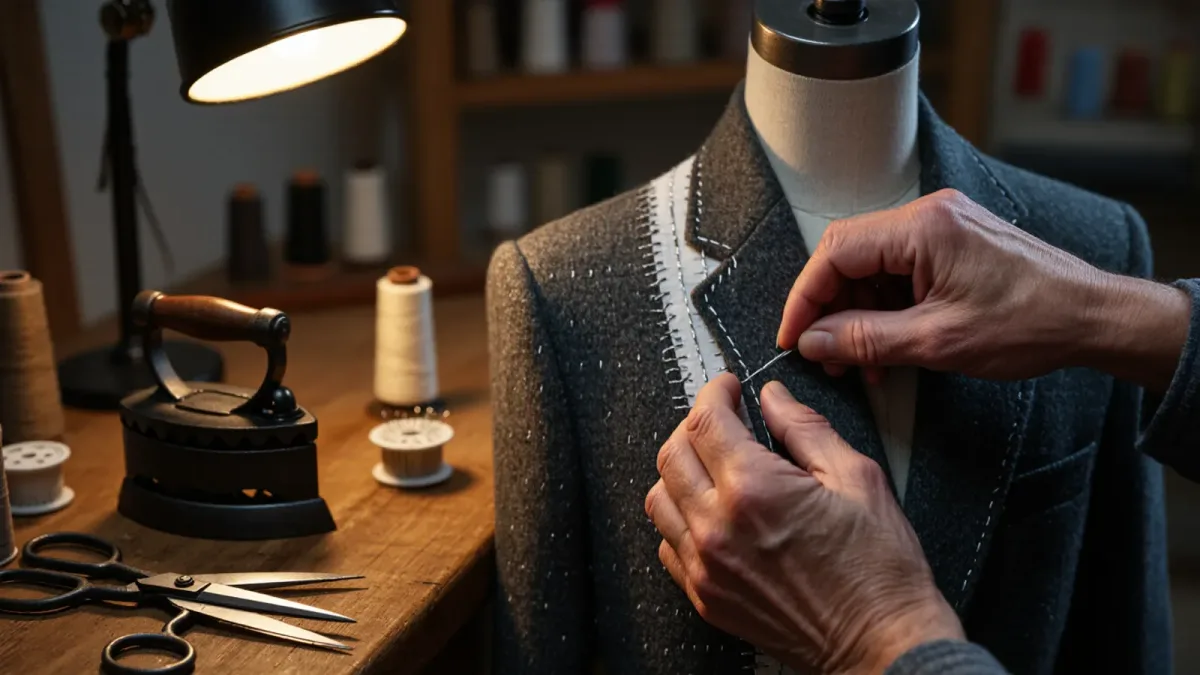
A tailored jacket's shoulder is a small piece of civil engineering: a horsehair canvas foundation, shaped with thousands of invisible pad stitches, layered over wool wadding and anchored to the cloth so the whole assembly curves over a living shoulder. It is also where jacket budgets diverge hardest — a fused construction can be sewn in minutes by machine, while a fully canvassed shoulder takes a tailor hours and keeps its shape for decades.
The economics follow directly. Fusing — a heat-activated glue layer bonded to the chest cloth — costs a couple of euros and delivers a flat, stiff chest that can bubble and delaminate after dry cleaning. Canvassing costs ten to forty times that in materials and skilled labor, but molds to the wearer over months of wear, which is why tailors describe a good jacket as needing to "learn" its owner.
The layers, from body outward
The chest assembly starts with hair canvas — a woven interlining stiffened with horsehair or camel hair, chosen because it holds a curve set by steam. A pad stitcher anchors it to the cloth with rows of diagonal hand stitches, each row slightly tensioned: closer stitching builds more curl in the lapel's roll line. Over that sit wadding pads at the shoulder point to build the smooth transition from collar to sleeve head, then the sleeve itself is eased in — the sleeve's tiny excess of fabric at the cap absorbs into a gathered crown with no pleats. A sleeve head set without easing puckers; with correct easing, the shoulder reads as one continuous line.
- Floating canvas test: pinch the chest fabric between fingers — a canvassed jacket shows three separate layers sliding; fused feels like one stiff sheet.
- The lapel roll: a canvassed lapel rolls over a soft break below the notch; a fused one folds on a crease.
- Neapolitan vs English shoulder: lightly padded and shirred versus built and structured — both legitimate, both canvassed.
Related stories: Counting the Hours: How Couture Embroidery Is Actually Priced · The Jacquard Loom: Where a Woven Pattern Becomes a Program.
How the shoulder drives the silhouette
Fashion's silhouette cycles — power shoulders in the eighties, soft shoulders in the nineties, the current preference for a natural line with a whisper of structure — are implemented almost entirely at this assembly. The same pattern reads as athletic, retro or slouchy depending on shoulder wadding thickness and sleeve-head treatment, which is why pattern-makers call the shoulder the jacket's steering wheel.
What to check before buying a blazer
Do the pinch test at the chest. Look for lapels that roll rather than crease. Press the shoulder point — a canvassed one feels springy, fused feels like a board or, worse, like nothing. Check the sleeve junction for puckers, and turn the jacket inside out: a visible canvas layer with hand stitching in the chest area is the single most reliable quality indicator in menswear, worth more than any label or fiber percentage on the tag.
Ready-to-wear tiers, and what each can promise
Construction tiers map cleanly to price. Full canvas — the entire chest assembly of hair canvas, hand pad-stitched — appears at bespoke and the best ready-to-wear; expect it to be advertised loudly, because it costs hundreds in labor. Half canvas places the assembly through the chest and lapel only, leaving the lower body fused: a sensible compromise that keeps the roll line honest at a mid price. Fused construction throughout is standard below that, and honest at its price point — the failure mode is not the first fitting but year three, after cleaning cycles have stressed the glue. Better fusing exists: resins and woven fusibles that survive far longer than the old reputations suggest. The buyer's method stays constant across tiers: pinch, roll-check, press the shoulder. If a jacket passes those tests and the price is low, you have found value; if it fails and the price is high, you have found marketing. No fiber percentage or country-of-origin claim overrides what the chest does under your fingers.
The takeaway
Spend on the shoulder before you spend on the cloth. Canvassing is the difference between a jacket that performs for five years and one that shapes to your body for twenty — and it is checkable in ninety seconds.