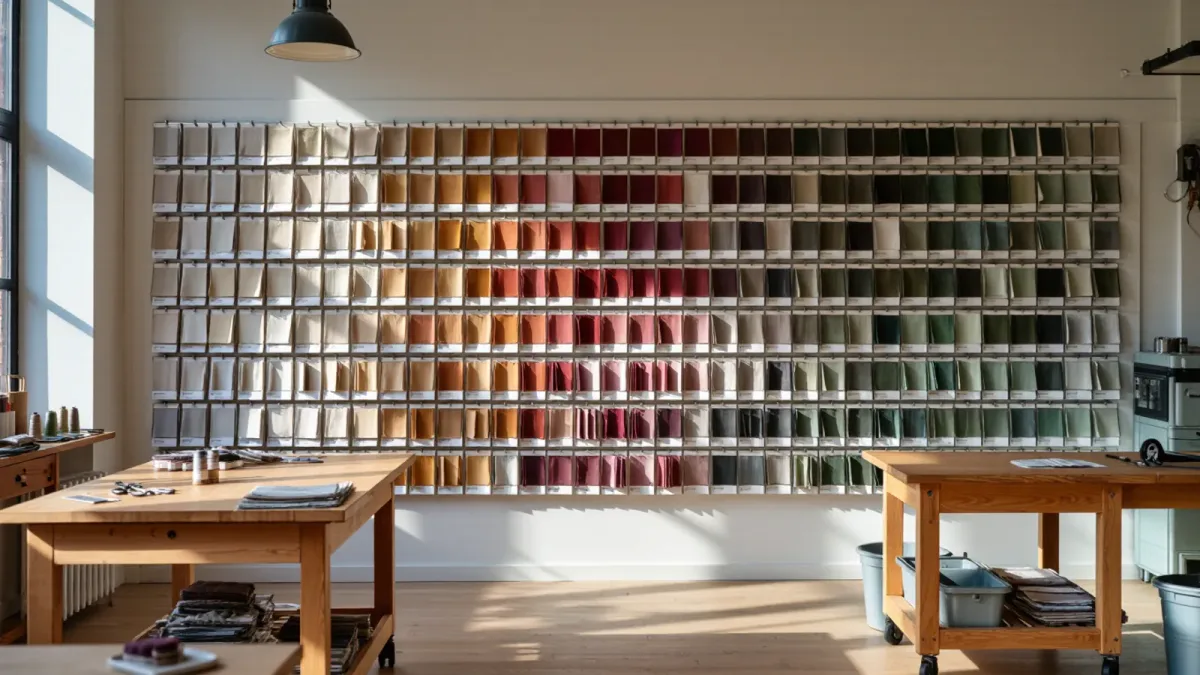
The pastel you are being sold this April was locked in roughly two years ago. Color forecasting runs on an 18-to-24-month pipeline: trend agencies publish directional palettes about two years ahead of retail, fabric mills dye their sample ranges about 18 months ahead, and brands finalize garment colors 9 to 12 months before a season lands on the floor. When you buy a spring coat, every hand in that chain signed off on its shade long before the season had a name.
Understanding that clock changes how you read color trends. A sudden palette is not a whim; it is the visible tip of a supply chain decision — and the shades that survive multiple seasons of that pipeline are the ones with structural, not just moodboard, support.
Who actually picks the colors
Three layers interact. Forecasting services — the color card systems used across the industry — convene international committees that meet roughly two years out to set directional palettes by region and market. Pigment and fiber suppliers then translate those directions into dye standards for mills, because a color only ships if it can be reproduced across cotton, wool and synthetics with acceptable fastness. Finally, each brand's design team selects from that menu, balancing forecast direction against its own archive codes: a house known for red will take the season's red and push it toward its own register.
- The famous annual anchor color is set even earlier, by a single company, and works mainly as a publicity umbrella.
- Mills gamble on color: dye lots are expensive, so forecast accuracy is a financial instrument, not aesthetics.
- Color names are marketing — the same dye standard ships as "butter," "mimosa" or "lemon curd" depending on the brand.
Related stories: Donegal Tweed: The Colored Knots That No Machine Pattern Predicts · Counting the Hours: How Couture Embroidery Is Actually Priced.
How to use the clock as a shopper
Buy color on the way down the pipeline, not at the top. When a shade debuts on runways, it is priced as a novelty; 12 months later it reaches the mid-market with the fit bugs worked out; two years in, it is at the discounter and about to look dated. The strategic move for an expensive garment is a near-seasonless color from the forecast's neutral core — off-whites, deep greens, chocolate — and saving trend shades for accessories with a shorter cost-per-wear horizon.
How to spot a color with staying power
Check across price tiers. If the same dusty blue appears at couture, in the mid-market and in paint catalogs in the same year, it sits on the multi-year palette rather than a single season's novelty. Those cross-market shades are the ones that will still look current in five years — which is the real test of whether a color deserves closet space.
The color card meeting, and how dissent is settled
The directional palettes begin in committee sessions where delegate representatives from each market argue season by season. The method is comparative, not mystical: delegates bring sales data, street-level observation from their regions, textile trade show feedback and social signals, then vote palettes into existence with documented rationale. Disagreement is the system working — a shade that only one region defends rarely ships; one that three regions converge on becomes the season's inescapable color. After ratification, the palette is published on the card system to subscribers, and the industry's supplier chain begins matching: dyers standardize the shades across fiber types, and mills build their sample ranges. The committee structure explains a pattern shoppers notice — why colors seem to arrive everywhere at once, then vanish together two years later. It is not collusion in any sinister sense; it is a shared calendar, and the brands that beat the system are the ones large enough to buy mills and set the palette rather than follow it.
The takeaway
Color is logistics. Learn the 18-to-24-month clock, buy directional shades late and cheap, and spend real money on the neutrals every forecast renews.