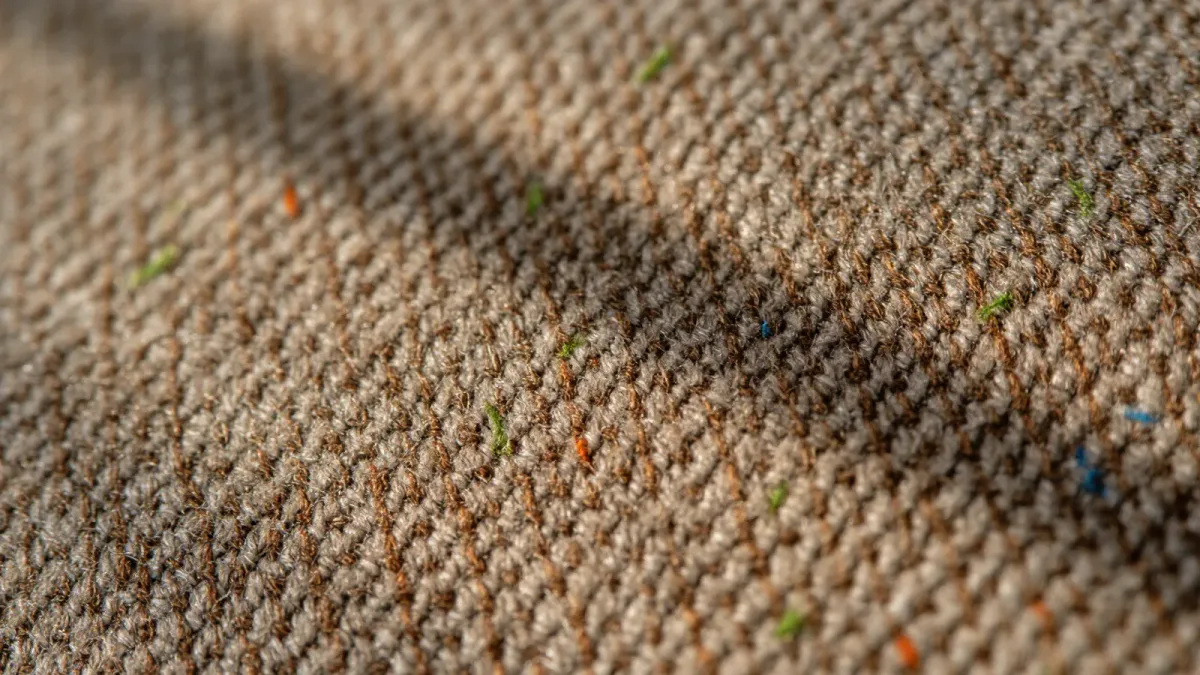
Donegal tweed is plain-weave wool flecked with short, brightly colored slubs called neps, spun into the yarn before weaving rather than applied afterward. The result is a fabric where the same mill's cloth varies batch to batch — two "identical" navy fleck jackets can carry visibly different confetti, because each nep was carded in by hand or by small-batch machinery in County Donegal or the Scottish mills that copy the style.
The technique answers a question worth asking of any winter fabric: how does pattern survive plainness? Donegal has no woven motif at all — its entire visual identity is entropy, controlled at the spinning stage.
How the flecks get in
Neps are short tufts of dyed wool, sometimes silk or cotton in luxury versions, added during carding — the process that aligns raw fleece into a spinnable web. Because the tufts do not fully integrate into the yarn, they sit slightly proud of the finished cloth, catching light and reading as color points from across a room. Traditional Donegal mills hand-tie neps into the sliver; larger producers inject them mechanically, which evens the distribution but flattens the character.
- Plain weave plus fleck: the simplest, most durable wool structure, ideal for hard-wearing jackets.
- Classic palettes: oatmeal with green and orange fleck, grey with blue, brown with rust — colors that came from local dyes and landscape.
- Weight matters: real Donegal tweed runs heavy, 400 grams per meter and up, which is why the cloth breaks in like denim.
Why it keeps returning to menswear and womenswear alike
Donegal does the job of pattern without pattern's risk. A flecked jacket reads as texture at conversational distance and as near-solid under evening light, so it pairs with checks, stripes and florals that would clash with a printed motif. That versatility, plus a supply chain of small Irish and Scottish mills, keeps it on runways every few seasons — and in the permanent collections of houses trading on country craft.
Related stories: Why Your Spring Colors Were Chosen Two Years Before You Saw Them · The Jacquard Loom: Where a Woven Pattern Becomes a Program.
What to check before buying
Press a fingernail into the cloth: good Donegal springs back because the wool is densely woven and well-finished. Look at the nep density across a full panel — machine fleck repeats in a suspiciously even grid, hand-fleck scatters. Open the jacket: a proper tweed jacket is canvassed through the chest, with the tweed's slubby hand visible inside the lining seams. And expect color variance between any two garments; it is the fingerprint of the process, not a defect.
From fleece to jacket: the mill pipeline
Donegal's chain is short enough to audit. Fleece is scoured and dyed in the wool — dyed before spinning, which gives the color depth that piece-dyed cloth cannot match — then carded with the nep tufts, spun, and woven on plain looms at regional mills. Handweavers on domestic looms still produce registered craft tweed in small quantities, heavier and more irregular than mill cloth, priced accordingly. Finishing is where the fabric is won: washing to relax the weave, milling lightly to raise the handle, and pressing with steam to set the hand. Brands that care name the mill and the region on the label; that naming is not marketing romance but a traceability claim you can verify, because Donegal's mills are few, documented and proud of contracts. The economic effect is real for wearers: short supply chains mean the premium you pay for genuine Irish cloth largely reaches the spinners and weavers, unlike the margin on a poly-blend imitation woven a hemisphere away and flecked with printed spots that fade to grey in a season.
The takeaway
Donegal tweed is craft you can verify by touch: proud neps, dense weave, no repeating fleck pattern. Buy the cloth, not the label — the mills are the story, and the story is checkable.