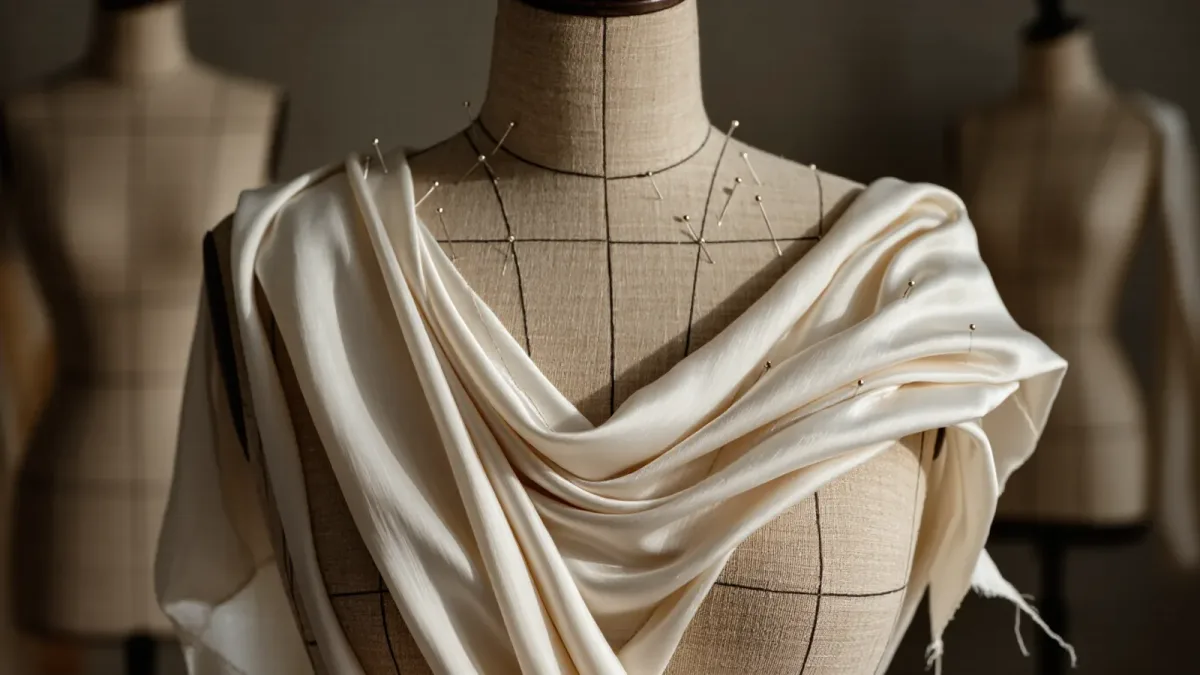
Draping — moulage in the French ateliers — is the practice of building a garment directly on a dress form, pinning and smoothing fabric until the silhouette appears, then tracing those pinned seams onto paper. A single draped bodice is typically worked in five to fifteen yards of inexpensive silk muslin, because only a fabric with silk's drape tells the truth about how the final cloth will fall.
Flatter-pattern drafting, the alternative, works flat with rulers and formulas and excels at tailored, stable garments. Draping wins wherever fabric behavior is the design: bias slip dresses, gathered bodices, cowl necklines, anything asymmetrical. Most studios use both, and the order says a lot about the house.
How a draped bodice actually happens
The draper tears a length of muslin on grain, presses it dead flat, and blocks it over the form, aligning the selvage with the center line. Straight pins anchor the cloth at bust and waist; excess is slashed and released so the fabric can round over the chest without pulling. Seams are marked in pencil directly on the muslin, style lines are trued with a curved ruler, then the whole thing comes off the stand, is pressed flat, and becomes paper pattern — the draped muslin itself often serving as the first pattern piece.
- Grain choice sets behavior: on the bias, cloth stretches and skims; on the straight, it holds structure.
- Every pin is a decision — ease, drape depth, and seam placement are fixed physically before any math.
- The stand must match reality: professional forms are adjusted to the house's fit model, not to an industry average.
Why couture and ready-to-wear split here
In couture, draping stays the primary method because each client is a new figure; the stand is padded to her measurements and the muslin becomes her toile. In ready-to-wear, draping is mostly a design-phase tool: the first prototype is draped for beauty, then flattened, graded and engineered for factories. That translation is where many mid-price garments lose the original line — a cowl that fell in sculptural folds on the stand turns into a limp flap when the factory substitutes a cheaper, stiffer knit.
Related stories: The Jacquard Loom: Where a Woven Pattern Becomes a Program · Why Your Spring Colors Were Chosen Two Years Before You Saw Them.
What to look for in a finished dress
Draped garments announce themselves. Check the bias: stripes or checks that join in continuous chevrons at side seams mean the cutter laid the pattern on true bias and handled the stretch. A cowl should fall in deep, even folds from a seam that lies flat — folds that spring back after wear indicate decent cloth weight. And on a slip dress, gravity is the test: hold it at one shoulder and watch whether the hem swings level.
Tools of the stand, and why they barely changed
The draper's kit is stubbornly low-tech: silk muslin by the bolt, a padded form adjusted with cotton batting to the fit model's measurements, twill tape for style lines, a style ruler, and weights that hold grain while hands are busy. The form itself is the most important tool — professional ateliers maintain forms for each fit model, rebuilt in batting whenever the model changes, because a drape balanced on the wrong stand produces a pattern that fights every real body. Digital tools have entered at the edges: some studios scan the draped muslin into 3D software and true seams on screen, and a few houses simulate drape before cutting. But the simulation still begins with a physical drape, because fabric behavior — the way crepe collapses, the way organza holds air — resists accurate modeling and the eye of a trained draper remains the cheapest accurate instrument the industry has.
The takeaway
Draping is the reason a beautiful dress looks effortless and takes weeks. Read the bias seams, the fold behavior, the balance of the hem — three checks that separate stand-built design from flat-pack imitation, at any price.