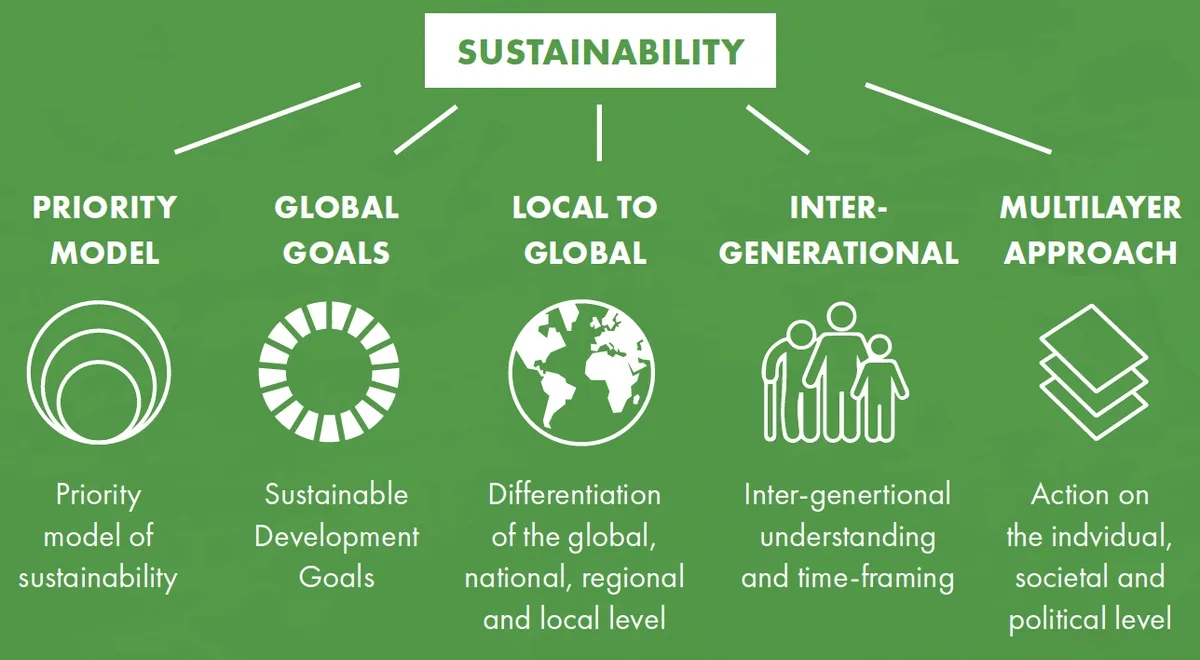
Sustainability means using resources in a way that lets them last. Wikipedia's entry gives the plain sense: a state in which the environment, the economy, and society keep going over a long period of time. The word names a goal, not a product. No label owns it.
The term entered mainstream policy in 1987. That year the United Nations issued Our Common Future, a report by the World Commission on Environment and Development. It carried the definition most people still quote. Development should meet the needs of the present without cutting off the needs of the future.
Where Did the Modern Word Come From?
The 1987 report is often called the Brundtland Report, after the commission's chair. Gro Harlem Brundtland, a former prime minister of Norway, led the commission. The text came out in October 1987 through Oxford University Press. Wikipedia's entry on the document records the scale of the work. It summed up a "900-day" exercise of written submissions and public hearings around the world. Scientists filed evidence. Industry filed evidence. Citizens did too.
The report placed the environment and development on the same page. It treated them as one issue, not two. That framing stuck. Most later definitions trace back to it. The style helped. The text is plain, and it still reads well today.
Is Sustainability the Same as Sustainable Development?
Close, but not identical. Wikipedia draws the line this way: sustainability is the long-term goal, while sustainable development covers the many processes and pathways that lead to it. One is the destination. The other is the road. For related coverage, see Secondhand Luxury Is Sustainability's Only Growing Market — With an Asterisk.
In everyday use the terms swap places. A company touts sustainable development when it changes a process. It claims sustainability when it says the change will hold. The pair is easy to blur. Labels blur it on purpose. The distinction matters when a claim is read closely.
What Are the Three Parts?
Most definitions now rest on three legs: environment, economy, and society. Wikipedia's entry lists climate change and biodiversity loss among the environmental problems the concept addresses. The economic leg is the contested one. Scholars debate how much growth can be balanced against conservation.
That debate has a name: weak versus strong sustainability. The weak camp allows trade-offs between the legs. The strong camp resists them. Wikipedia notes the tension plainly. Welfare and prosperity for all pull against environmental conservation, so trade-offs become necessary.
Picture a stool with three legs. Cut one short and the seat tips. The frame works the same way. A firm that saves a forest while it drains a river has not balanced the legs. It has moved the tip.
Why Does the Word Get Misused?
Because it is hard to measure. Wikipedia states it directly: sustainability is complex, contextual, and dynamic, and there is no fixed definition of its indicators. The toolkit keeps changing. It includes benchmarks, audits, and certification systems such as Fairtrade and Organic, as the same entry records.
For a buyer, the practical test is simple. Ask what document sits behind the word. A standard, an audit, or a registry is evidence. The honest answer to most green questions is: it depends. Scope decides. So does the baseline. A word without a method is only a mood. When a brand uses the word with no proof behind it, treat it as the brand's claim, not as a fact.
Conclusion: A Test of Endurance, Not a Badge
The word has a real meaning. It asks whether a practice can continue over a long period without running down what it depends on. The Brundtland Report gave the concept its working definition in 1987, and the three-part frame still holds. What has decayed is casual use. So read the word the way an auditor would. Ask how long, at what cost, and with what proof. Answers that survive those questions have earned the label. The rest is decoration. This connects to our earlier piece, Regenerative Cotton and Wool: What 'Regenerative' Actually Means on a Label.