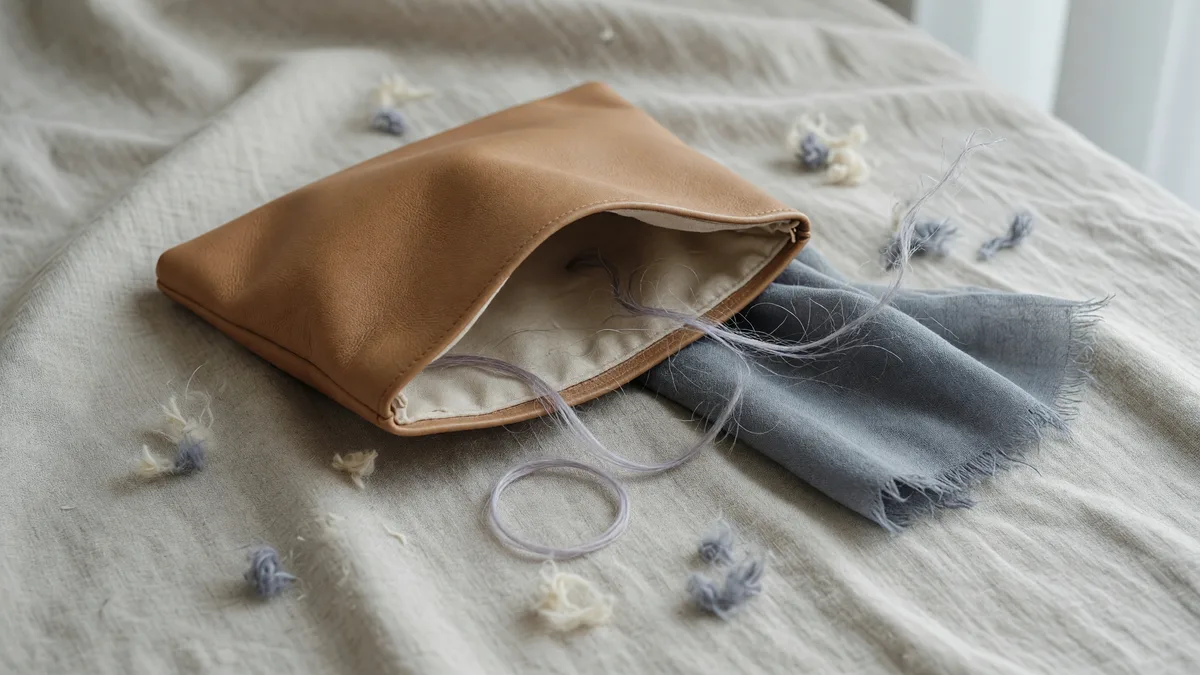
Every time a synthetic garment goes through the wash, it sheds tiny plastic threads called microfibers. According to the U.S. National Park Service, the tumbling, vibration and friction inside a washing machine dislodge fibers from polyester and acrylic fabric, and those fibers travel straight into the wash water. A single load can release a very large number of them, and most are small enough to pass through standard water treatment.
This isn't a defect in any one garment. It's a property of how synthetic fabric is built. Woven and knitted synthetics are made of continuous plastic filaments, and every wash cycle breaks a few loose. The looser the weave, the more comes off. A fleece jacket sheds far more than a tightly woven shell, because a fluffier structure gives fibers more surface area to catch on and tear away, as the Conversation explains.
How Do Microfibers Get From a Washing Machine Into the Ocean?
Fibers leave the drum in the rinse water and travel down the drain to a wastewater treatment plant. Advanced plants can strip out the vast majority of what arrives, but with millions of fibers in a single load's discharge, according to the Conversation, even a small leftover fraction adds up fast once you multiply it across a city's laundry.
What treatment plants do capture doesn't disappear. It ends up in sewage sludge, which is frequently applied to farmland as fertilizer. That means microfibers move from your washing machine into soil, into the plants grown in that soil, and up the food chain, per the same reporting. The fibers that do reach open water are eaten by fish, mussels and clams, and from there they enter the food humans eat, according to the National Park Service.
The fibers themselves aren't inert plastic alone. They often carry dyes, anti-wrinkle finishes and flame retardants, and once in water they can pick up additional contaminants like metals and pesticides that stick to the fiber's surface, the Conversation reports. Marine science summaries from the Pacific Salmon Foundation's marine science program describe the same accumulation happening in fish, seabirds and marine mammals along the coast, where microplastics fill stomach space without offering nutrition and disrupt normal feeding.
Does Fabric Choice Actually Change How Much Sheds?
Yes, but not as cleanly as the marketing suggests. Cotton, linen, wool and other natural fibers do shed less harmful material, because their fibers biodegrade rather than persisting as plastic, per the National Park Service. Read the full mechanics of certification claims in this decoder of fashion's certification alphabet before you take an eco-label at face value on fiber content alone.
Natural fibers still shed, though. Cotton and wool release their own fibers into wash water; those fibers just break down in the environment instead of persisting as plastic for decades, according to both the National Park Service and the marine science program. Swapping fleece for wool reduces harm, not the volume of shedding itself.
Fabric structure matters as much as fiber type. A loosely woven or brushed fabric, like fleece, sheds substantially more than a tightly woven one, the Conversation notes, because loose weaves expose more fiber ends to abrasion. If you're choosing between two polyester garments, the tighter, denser weave is the lower-shedding one, all else equal.
What Actually Reduces Shedding at Home?
Wash less often and only run full loads. A fuller drum means less friction between individual garments, and friction is the direct mechanical cause of fiber loss, per the National Park Service. Consider whether cost per wear changes your view of how often a garment truly needs a wash; the arithmetic is laid out in this piece on the slow fashion math that survives a spreadsheet. For related coverage, see Cost Per Wear: The Slow Fashion Math That Survives a Spreadsheet.
Cold water and shorter cycles help too. Warmer water and longer agitation both increase fiber release, according to the marine science program, and a front-loading machine sheds less than a top-loader because it lacks the aggressive central agitator that drives fiber loss in top-load designs.
- Wash full loads only, on cold, on the shortest effective cycle.
- Choose a front-loading machine where you have the option.
- Skip the dryer when you can. A National Park Service pilot study found dryers release more microfibers into the air than washing machines do, with little filtration between the vent and the outside air.
- Retrofit an external filter. A 2018 University of Toronto and Ocean Conservancy study, cited by the National Park Service, found one after-market filter captured 87% of the microfibers shed by fleece blankets in the wash.
- Try an in-drum device such as a fine-mesh laundry bag or a fiber-catching ball, understanding they capture a smaller share than a full external filter, per the Conversation's review of the evidence.
Where Does Regulation Stand on Washing Machine Filters?
France has legislated that all new washing machines carry filters by 2025, and Australia has announced a requirement for commercial and residential machines by 2030, according to the Conversation. California passed a similar filter mandate in 2023, but the measure was vetoed over cost concerns to consumers, the same reporting states. No comparable federal requirement exists in the United States at this time.
Where a filter is voluntary rather than mandated, the choice sits with the household. External filters cost roughly $150 on average and need periodic cleaning, with the trapped fiber waste disposed of as solid waste rather than rinsed back down the drain, per the Conversation. That single detail — don't rinse the filter into the sink — is the part most buying guides skip.
What This Means for a Buy-Less Wardrobe
Shedding isn't a reason to abandon synthetics outright; many perform functions natural fibers can't match for durability or weather resistance. But it is a reason to weigh fabric and finish alongside price when a garment enters your wardrobe, the same way you'd weigh what a regenerative fiber claim actually means on a label. We covered a connected angle in Regenerative Cotton and Wool: What 'Regenerative' Actually Means on a Label.
A tightly woven synthetic worn for years sheds less over its lifetime than a fleece piece washed weekly and discarded after a season. Longevity is itself a mitigation strategy: fewer wash cycles, fewer total fibers released, regardless of fabric.
The research here doesn't establish a single fix. It establishes a set of choices that each help a little: wash less, wash cold, wash full, dry with air where you can, and filter what you can't avoid. None of it is dramatic. All of it is what the evidence actually supports.