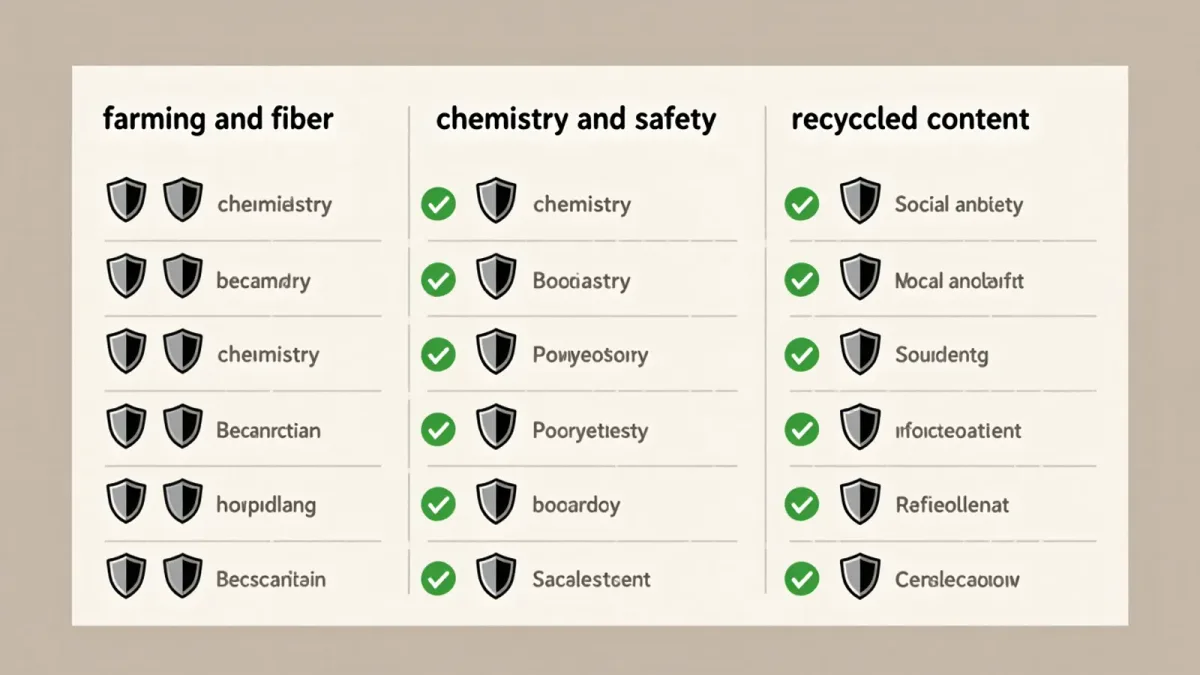
Fashion uses more than a hundred sustainability labels and certification schemes across the EU alone, per the European Commission's own count behind its 2024 Green Claims directive — a proliferation the regulators themselves now treat as a consumer-protection problem (European Commission, 2024). For a shopper, the field reduces cleanly once you sort labels by what they actually verify: farming, chemistry, recycled content, or nothing verifiable at all. This decoder covers the ones worth knowing and the four questions that test any label.
Above Magazine verifies green claims against materials, certifications and supply-chain facts; labels are audited here on scope and governance, not on their marketing.
What does GOTS actually certify?
The Global Organic Textile Standard certifies organic fiber — cotton, wool — through processing: it starts at the farm with certified organic fiber and follows the chain of custody through spinning, dyeing and manufacture, with strict chemical and wastewater criteria and social criteria at the processing level. It is the most complete garment-level label for natural fibers and the one most often mimicked by lookalike language ("organic-compliant," "GOTS-style"). Two grades exist: "organic" requires 95 percent certified organic fiber; "made with organic" requires 70 percent. Check which grade, and check the license number in GOTS's public database — a GOTS claim without a license number is decoration.
GRS versus RCS: what is the difference?
Both certify recycled content via chain of custody. The Global Recycled Standard (GRS) adds chemical processing restrictions and social criteria; the Recycled Claim Standard (RCS) verifies only the recycled content percentage. So a fabric can be RCS-certified with 20 percent recycled content and zero social requirements, while GRS demands more. Neither says anything about the fiber being better for the planet at farming level, and neither distinguishes pre-consumer from post-consumer waste — ask which one, because recycled factory offcuts are a lower bar than recycled consumer waste. A garment labeled just "recycled" with no GRS/RCS transaction certificate is an unaudited claim.
What does Oeko-Tex actually test?
Oeko-Tex Standard 100 tests the finished textile for a list of harmful substances — formaldehyde, heavy metals, certain dyes. It is a chemistry safety test, not a sustainability claim, and its misuse is the most common sleight in the aisle: a hangtag pairing Standard 100 with the word "organic" lets a chemical test stand in for a farming certification. It is genuinely useful for what it does — skin-contact safety, baby clothing — but it says nothing about how the fiber was grown or whether workers were paid.
And the rest worth knowing?
- Regenerative Organic Certified (ROC): the strictest soil-level label, requiring organic baseline plus soil health, animal welfare and social fairness.
- LEATHER WORKING GROUP: audits tanneries on environmental practice — useful for leather, but check the rating (Gold to Audited), not just membership.
- Responsible Wool Standard: verifies animal welfare and land management in wool; stronger on welfare than on land outcomes, where regenerative programs go further.
- B Corp: audits the company's governance, not any product; a B Corp can still sell a polyester-blend, air-freighted collection.
Related stories: Regenerative Cotton and Wool: What 'Regenerative' Actually Means on a Label · How to Detect Greenwashing in Fashion: Five Checks That Take Ten Minutes.
The four questions that test any label
- Third party or self-declared? Regulators have been specifically targeting self-made eco-badges; the EU's Green Claims directive requires third-party verification for environmental claims.
- What scope? Farming, chemistry, content, labor, or the whole company — most confusion comes from a label answering a question it was never asked.
- Can I verify it? Every serious scheme runs a public database of certificate holders. If the claim cannot be looked up, it does not count.
- What percentage? Content-based labels have thresholds; the grade — 95 percent versus 70 percent versus 20 percent — is where most labels hide their truth.
Per Reuters coverage through 2025-2026, enforcement actions over environmental claims have been rising on both sides of the Atlantic (Reuters, 2026) — the unverified badges are being squeezed out, which makes the verified ones easier to trust and to check.
How do certifications stack when they overlap?
Real garments often carry several labels, and the combination tells you where a brand's effort actually went. A shirt with GOTS fiber, GRS recycled buttons and a social-compliance sewing audit represents three verified supply-chain links — farming, components, labor — and such stacking is expensive to fake, because each scheme audits a different tier with separate license numbers. By contrast, a garment with one self-declared hangtag and one chemistry test (Oeko-Tex) has covered a single, narrow slice and dressed it as a philosophy. A useful habit when claims compete: prioritize the label that audits the highest-footprint stage. For cotton garments that is farming (GOTS territory); for synthetics it is the feedstock question (recycled content standards); for leather it is the tannery (working-group audits). No single label covers everything, which is exactly why the stacked garment is the credible one — and why the four verification questions from the main checklist apply to each label individually, since a stack is only as strong as its weakest certificate number.
One last scope trap deserves its own paragraph: company-level versus product-level claims. A brand can hold a company-level certification — governance, climate accounting, labor auditing across the business — and still sell an individual garment with no verified attributes at all; conversely, a small label can sell a fully certified product while the company behind it is opaque. The decoder's questions work at the level where the claim sits: product claims need product certificates, company claims need corporate reports with numbers and named auditors. Confusing the two levels is how marketing converts one credential into an aura across an entire range — the single most efficient move in green marketing, and the easiest to catch once you read every claim at its own altitude. The label on the hangtag answers for that garment; nothing else, however green the brand's homepage, answers for it with you.
The takeaway
Memorize the scope map and you carry the decoder with you: GOTS for farming-to-garment natural fiber, GRS or RCS for recycled content (GRS if you want the extra bars), Oeko-Tex for chemistry only, ROC for the strictest soil claims. Everything else gets the four questions — and a label that fails them is not a certification, it is a suggestion.