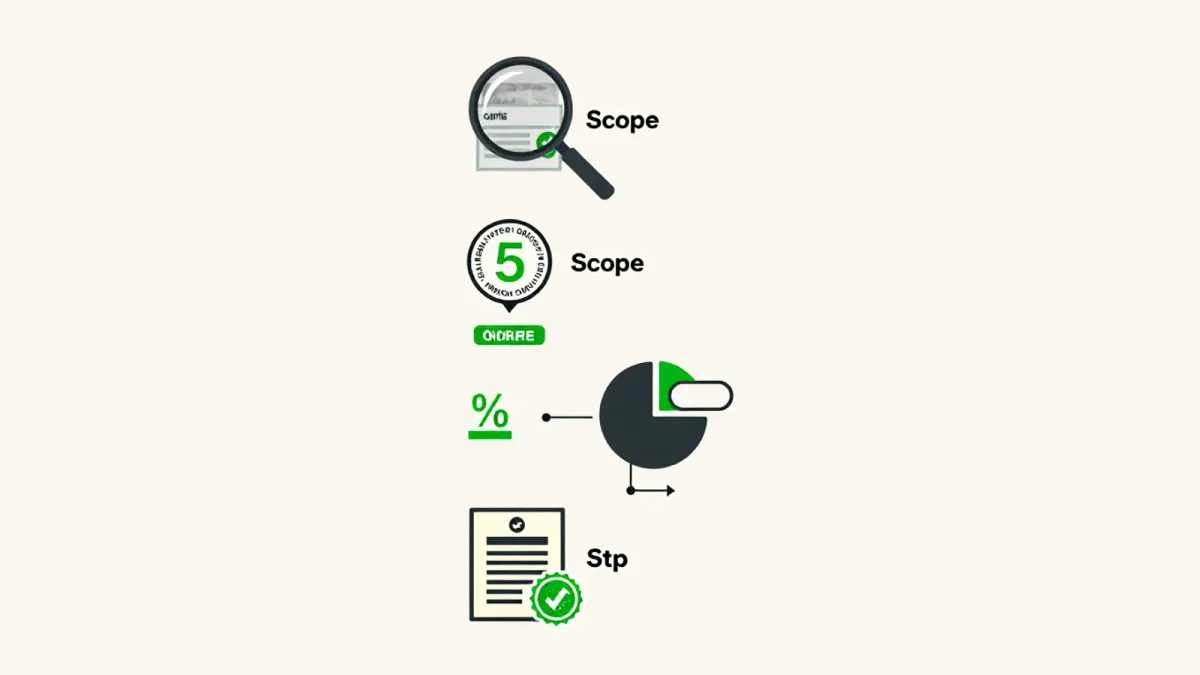
Most greenwashing in fashion fails a simple test: the claim is real-sounding, but it names no material, no percentage, no certification and no scope. The FTC's Green Guides — the US reference for environmental marketing since 2012 and under revision since 2022 — say environmental claims must be specific, substantiated and qualified (FTC, 2012). That gives any shopper a checklist. Ten minutes, five checks, and the decorated brands separate from the documented ones.
Greenwashing is not always lying. More often it is a true statement placed where it implies more than it says — a recycled hangtag on a garment that is 4 percent recycled, a "conscious" capsule while the main line is unchanged. The checks below are built for that pattern.
Check 1: Is the claim specific or an adjective?
"Conscious," "eco," "green," "responsible," "better" — the Green Guides treat unqualified general environmental benefit claims as presumptively deceptive because no product has one. A verifiable claim names the thing: "100 percent GOTS-certified organic cotton," "lining made of 78 percent recycled polyester certified GRS." When you see an adjective, ask the obvious question — to what, exactly, compared with what? Brands with real programs answer in materials and percentages; the rest answer in mood. sustainability coverage.
Check 2: Is there a certification, and is it the real one?
Third-party certification is the cheapest way to outsource verification, but the logo matters less than the scope it covers. GOTS (Global Organic Textile Standard) certifies the organic fiber through processing; OEKO-TEX Standard 100 tests the finished textile for substances but says nothing about how it was grown; GRS and RCS certify recycled content with different chain-of-custody rules. A hangtag citing Standard 100 next to the word "organic" is one of the most common sleights in the industry — a chemical-safety test standing in for a farming claim. Check which standard, which scope, and whether the certificate number can be looked up in the standard body's public database.
Check 3: What is the denominator of the recycled claim?
"Made with recycled materials" can mean 3 percent of the trim. The useful number is the percentage, by weight, of the whole garment — including buttons, zippers, thread and labels. If a brand publishes a percentage without saying what share of the garment it covers, that omission is itself information. The same discipline applies to water and carbon claims: per what unit, measured how, verified by whom?
Check 4: Does the claim cover the collection or a capsule?
The capsule maneuver — a small "sustainable" line funding the brand's image while the main line runs unchanged — is the dominant pattern in high-street greenwashing. Two questions expose it. What share of the total collection does the sustainable line represent? And has the brand's total production volume gone up or down over the past three years? A brand whose volume grew 40 percent while launching a "circular" capsule has, in net material terms, made the problem larger. Per Reuters reporting through 2025, regulators in both the EU and the US have opened actions against brands over exactly this kind of offsetting claim (Reuters, 2025).
Related stories: GOTS, GRS, RCS, Oeko-Tex: A Decoder for Fashion's Certification Alphabet · Regenerative Cotton and Wool: What 'Regenerative' Actually Means on a Label.
Check 5: Is there a path to verify the numbers?
The strongest signal is not a claim but an infrastructure: published supplier lists, an annual materials breakdown, a named standards body, a data methodology you can read. The EU's upcoming Digital Product Passport will force this disclosure onto EU-bound goods, but a brand ahead of the law publishes the same data now. If verification requires trusting a marketing page — no methodology, no third party, no named standard — treat the claim as decoration.
The fifty-word rule
Here is the compression of all five checks. A credible green claim names the material, the percentage by weight, the certification body, and the scope — in about fifty words. Claims shorter than that are usually hiding a denominator; claims longer without those four facts are usually hiding a claim. Both disqualify.
What to do with what you find
You do not need to prove deception — you need to price uncertainty. A brand that cannot specify its materials is asking you to buy an adjective. Given the price gap between real certified supply chains and conventional ones is usually modest, a claim that cannot survive ten minutes of checking rarely deserves the premium it charges. Keep the checklist; the ads will not get more honest on their own, but the EU's 2024 empowerment of consumer authorities to police environmental claims without case-by-case proof is already pushing the market toward your side.
What is changing in the law while you shop?
The regulatory direction is one-way: toward claims needing proof. In the EU, the 2024 empowerment of consumer authorities — the Empowering Consumers directive working alongside the Green Claims measure — requires substantiation and, progressively, third-party verification of explicit environmental claims, and bans generic claims without recognized excellent performance, with offsetting-based labels like climate neutral scheduled out of EU commerce. In the US, the FTC's Green Guides revision, in progress since 2022, is expected to tighten guidance on offsetting, recyclability and certification seals, and state-level laws — California's climate-disclosure regime for large companies foremost — already force carbon accounting that marketing claims must eventually match. The practical consequence for a shopper through 2026: vague claims are becoming legally riskier for brands, which means their disappearance from hangtags is a signal in itself — the brands rushing to quantify are the ones with something to quantify.
A closing note on tone, because detection has a failure mode of its own: cynicism. The framework above is designed to separate claims into three bins — verified, unverifiable, and false — and only the third deserves contempt; the second is an invitation to ask better questions, and the first deserves the purchase. Brands respond to which behavior is rewarded, and the shopper who emails a company for its certification scope, or chooses the verified alternative at a fair premium, is casting the only vote the market actually counts. Ten minutes per purchase, five checks, one standard: if the claim cannot name its material, percentage, certification and scope, it has not made a case — and no wardrobe ever got worse for waiting until someone did.