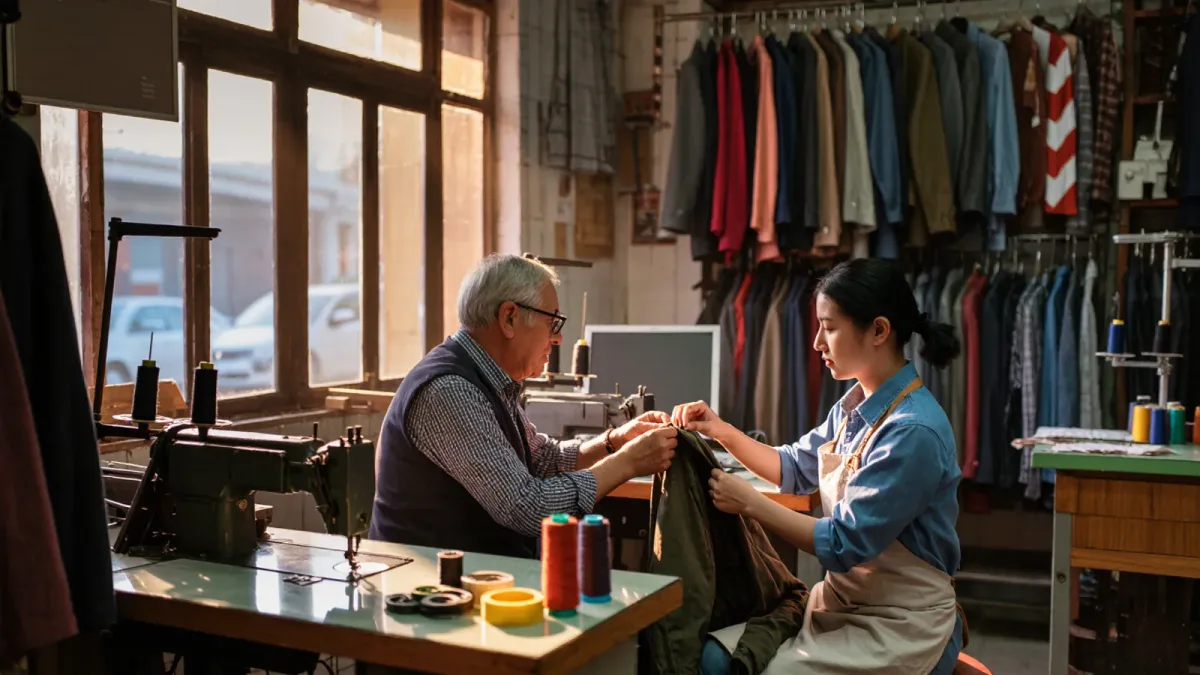
Extending the life of a garment by just nine extra months of active use reduces its carbon, water and waste footprints by around 20 to 30 percent each, per the landmark Wrap UK study that industry calculations still cite. That single number explains why repair — once the business of cobblers and grandmothers — is being rebuilt as an industry: brand repair services, repair subscriptions, resale platforms with in-house mending, and EU legislation that starts treating durability as a regulated property rather than a virtue.
Above Magazine publishes information, not purchasing advice; programs described are current as of early 2026.
What is driving the repair boom — culture or law?
Both, in that order of visibility but reverse order of durability. Culturally, visible mending and repair cafes normalized fixing clothes again. Legally, the EU has been converting repairability into binding requirements: the Ecodesign for Sustainable Products Regulation empowers product-group durability rules, and the EU's right-to-repair directive, adopted in 2024, obliges manufacturers of covered goods to repair on reasonable terms and created a European online repair platform matching consumers with repairers (European Commission, 2024). Textiles enter ecodesign requirements progressively this decade, which means apparel repair obligations are a matter of delegated acts, not of debate.
What do brand repair services actually offer?
- Lifetime or long-term repair commitments from outdoor and heritage brands — free or flat-fee repairs of seams, zippers and down fill, often for the garment's usable life.
- Denim repair programs that reweave or patch jeans, increasingly bundled with buy-back offers.
- Repair-plus-resale hybrids, where a brand repairs returned goods before authenticating and reselling them, keeping the margin from a second sale instead of losing the customer to a peer marketplace.
- Local partnerships with alteration shops and tailors, subsidized by the brand through voucher codes — the cheapest way to look committed without building workshops.
The economics matter: every repaired garment competes with a new sale, so brand-run repair is only durable when attached to loyalty economics — a repaired customer buys the next piece — or when regulation removes the choice.
Is repairing always the better option?
Not mechanically obvious, but usually. Repair beats replacement for garments with high production footprints — outerwear, denim, leather — and for damage that is localized: seams, zips, holes, worn cuffs. It makes less sense for thin, cheaply constructed basics, where a repair can cost more than the garment and the rest of the garment fails soon after. The honest test is the cost-per-wear extension: if a $30 repair buys two more years of weekly wear, it beats most new purchases on every metric including the ledger.
Related stories: The EU Digital Product Passport: What a QR Code Will Tell You About Your Clothes · Fiber-to-Fiber Recycling: The Technology That Could Make Old Clothes New.
How do you actually get a garment repaired?
- Check the brand first. Outdoor, denim and heritage brands frequently run mail-in repair you never thought to ask about; the service exists whether or not it is advertised.
- Use the EU repair platform if you are in Europe. The national platforms list vetted repairers with published terms.
- Find a alterations tailor for structural work. Zip replacement, reseaming and taking-in are standard trade work, typically $15–60 per job in US cities.
- Learn three repairs yourself. Button attachment, seam re-stitching and patching cover most of a wardrobe's lifetime failures; a basic kit costs less than one repair order.
Per Reuters reporting through 2025, repair and resale were the two fastest-growing business lines in fashion's circular economy segment (Reuters, 2025) — growth that regulation will accelerate further.
What does the repair economy mean for tailors and resellers?
The labor market is the quiet buildout under the consumer story. Repair work is local by nature — it cannot be offshored — and the sector's growth has created a training and employment lane from alterations shops up through brand service centers, where technicians earn stable wages maintaining the goods a maison sold years ago. Brands have responded by formalizing the trade: certified repair training programs, parts distribution to partner shops, and service warranties that give repairers access to original hardware and materials. For consumers, the practical consequence is quality: repairs done with original components hold up and hold resale value, whereas aftermarket fixes — a replaced zipper in the wrong tape color, non-matching thread — visibly discount a garment on the secondhand market. If you own investment-grade clothing, it is worth asking a tailor whether they work with brand-supplied parts, and worth keeping the receipts: documented repair history is to a coat what a stamped service record is to a watch — proof that the remaining wear count is real.
A final calibration on expectations: the repair economy is not a promise that everything can be saved, and part of its value is diagnostic. A good repairer triages honestly — this seam is worth restitching, this lining is worth replacing, this garment's shell will fail before the repair pays back — and that triage is itself consumer education unavailable anywhere else in the retail experience. Learning to hear it changes buying: garments constructed with repair in mind (substantial seam allowances, replaceable hardware, unlined simplicity) reveal themselves under a repairer's eye long before they fail on your back. Some careful shoppers now consult a tailor before an expensive purchase rather than after the first tear, the way buyers of used cars consult a mechanic. It inverts the usual order of the transaction — the expert sees the object before the money moves — and it is, structurally, the same discipline this publication recommends at every price level: verification before purchase, maintenance as ownership.
The takeaway
Before you replace a garment, run the two-question triage: is the damage localized, and does the brand offer a repair path? If both answers are yes, repairing is cheaper, lower-impact and — under EU rules arriving product group by product group — increasingly your right. The wardrobe that survives the next decade will be the one you can fix, and the brands that survive with it will be the ones that fix things with you.