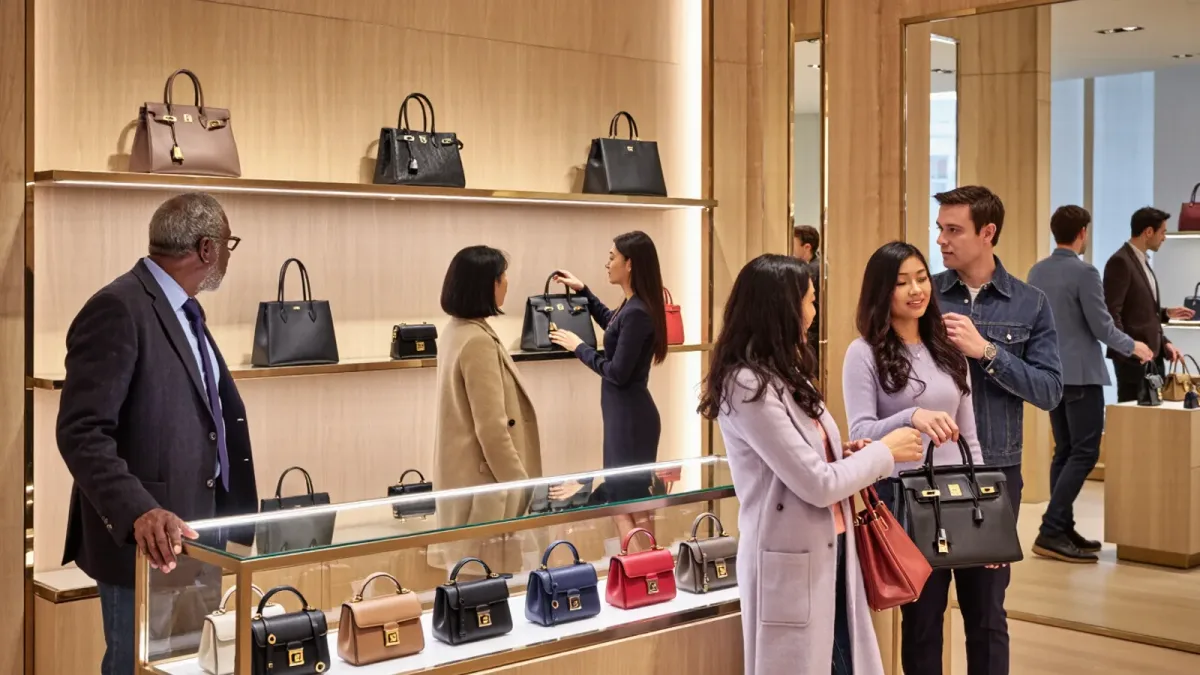
The secondhand luxury market has grown at roughly double the rate of new luxury for years — analysts have repeatedly sized it in the tens of billions of dollars globally, with growth projections near 10 percent annually through the decade, per figures reported by Reuters and industry analysts (Reuters, 2025). That makes resale the one fashion business model where environmental benefit and commercial incentive genuinely point the same way. The asterisk: the benefit only counts against the right baseline, and most resale marketing quietly borrows the wrong one.
Why is resale the strongest sustainability claim in fashion?
Because its arithmetic is mechanical, not aspirational. The overwhelming majority of any garment's footprint — commonly cited at 70 to 80 percent — sits in production: fiber, dyeing, finishing, assembly, transport. A secondhand transaction skips all of it. No new cotton, no new dye bath, no new factory run. Unlike recycled polyester (which still requires industrial processing) or organic cotton (which still requires farming), a pre-owned Birkin requires nothing but authentication and shipping. Every additional resale cycle divides the original production footprint across more wear-years.
Where the asterisk comes in
The avoided-impact claim only holds if the resale purchase substitutes for a new purchase. If someone buys a pre-owned bag who would otherwise have bought nothing, the transaction added consumption — money, shipping, packaging — with no avoided production. Economists call this the rebound effect, and resale's commercial success makes it acute: when platforms gamified handbag hunting into a collectible asset market, some of the buying became speculation, and speculators do not displace new-goods purchases. The honest framing for a consumer is simple: resale is sustainable as a replacement behavior, not as a collecting hobby.
How does resale change the brands' economics?
Brands spent years fearing resale would cannibalize new sales; the emerging reality is more nuanced and, from a sustainability standpoint, promising. Resale value functions as a price signal that rewards durability: a bag that holds 90 percent of its retail value is one whose owner can justify a premium purchase, and whose maker has a financial reason to build for longevity. Several major houses now run certified resale programs that authenticate, repair and resell returned goods — converting a threat into a second revenue line with near-zero production cost. This is the structural shift to watch: when a house earns from the second sale, it stops being indifferent to the first sale's lifespan.
What should a resale buyer actually check?
- Authentication standards. Ask what the platform verifies — serials, stitching, hardware, materials — and whether it issues documentation. Verification claims have drawn legal scrutiny in recent years, so documentation matters.
- Condition grading honesty. Look for platforms that publish photographs of the actual item, not stock photography, with graded wear on corners, handles and hardware.
- Return policy. A platform confident in its authentication offers returns; one that does not is asking you to underwrite its errors.
- The substitution test. Before buying, name the new purchase this displaces. If nothing, you are collecting — enjoy it, but do not file it under sustainability.
Related stories: GOTS, GRS, RCS, Oeko-Tex: A Decoder for Fashion's Certification Alphabet · How to Detect Greenwashing in Fashion: Five Checks That Take Ten Minutes.
Does certified brand resale differ from peer marketplaces?
In service level and margin, yes; in environmental arithmetic, no. Brand-run programs offer repairs, refurbishment and warranties that peer marketplaces cannot, which raises the number of use-cycles per item — a genuine gain. But the impact comes from the transaction happening at all, whoever runs it. Peer marketplaces often deliver the same reuse at lower prices, which matters for who gets access to durable goods.
How does resale change what gets designed?
The feedback loop from secondhand prices into design decisions is the quiet structural story of the resale boom. When secondary-market data is rich enough, a brand can see which constructions survive ten years of wear — which linings tear, which hardware platings wear through, which leathers crack — and designers planning multi-year icon programs increasingly source that data rather than intuition. The visible results: more brands specifying repairable constructions in icons, hardware upgraded from plated cast alloy to solid brass, spare parts and hardware kits offered to service centers, and care documentation written for a decade rather than a season. None of this appears in a sustainability report as a headline, but it is where circularity becomes real: durability engineered from observed failure is worth more than any take-back program. The resale market, in effect, runs the world's largest durability experiment — and the brands reading its results are the ones whose products you will still find on its racks in ten years.
There is also a timing dimension to the substitution logic worth naming. Resale is not equally green across a product's life: buying a two-year-old bag that a first owner barely used is close to pure displacement — the original production is amortized over your years at nearly zero added footprint. Buying a twenty-year-old vintage piece that needs restoration adds repair inputs, which are still smaller than new production. What sits least comfortably in the ledger is the newly emerging arbitrage where scarce references are bought at retail and flipped within months at a premium — a transaction that added a new production sale, a shipping footprint, and zero displacement. The market cannot stop speculation, but an individual buyer can simply decline to be its demand signal: the test remains the same at every price point — name the new purchase this displaces, and let that answer, not the asset story, make the decision.
The takeaway
Resale is fashion's most defensible sustainability claim: production skipped is production avoided, and the model scales because it profits. Use it as substitution — one pre-owned purchase standing in for one new one — and the arithmetic holds at the individual level the way it holds at the market level. Buy it as sport, and the market's greenest channel becomes just another way to own too much.