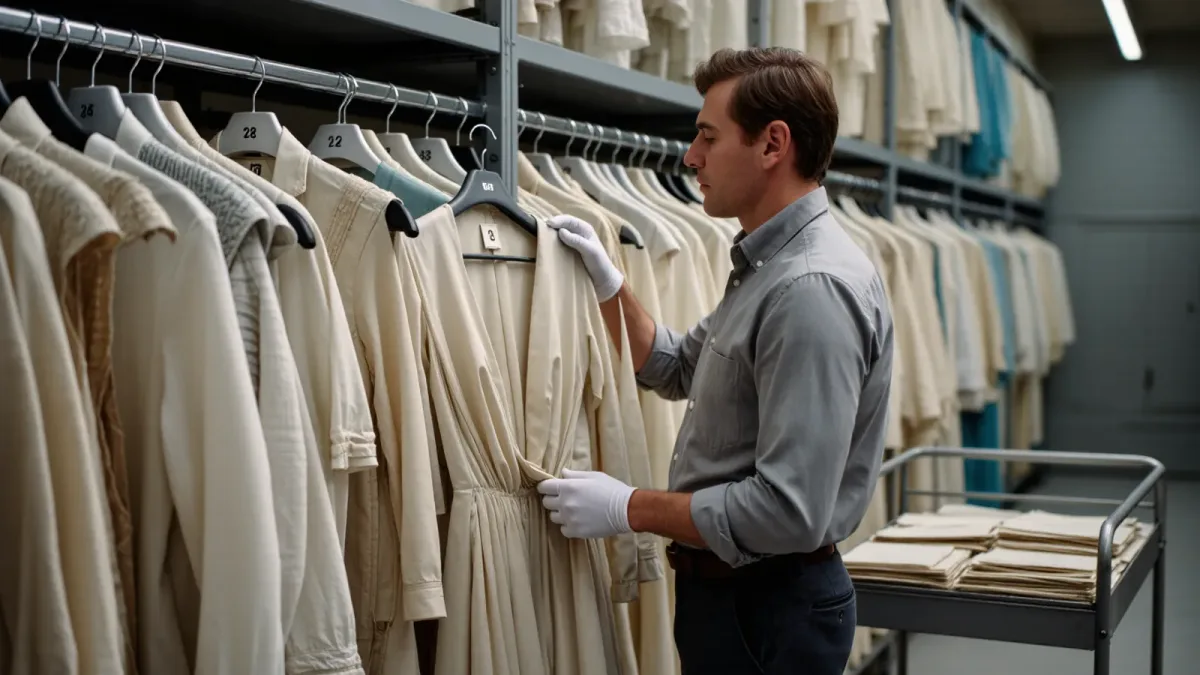
Every major fashion house maintains an archive, and for most new creative directors it is the first workplace: before sketches, before fittings, weeks inside a climate-controlled vault with numbered garments from every era. A single house archive can hold tens of thousands of pieces — runway samples, toiles, swatch books, sales records — stored at controlled temperature and humidity, handled with gloves, cataloged like a museum's collection.
The archive is not nostalgia infrastructure. It is the house's working memory: proof of construction techniques, the legal record of signature motifs, and the fastest available answer to the question every new designer faces — what does this brand mean?
How an archive actually gets used
Three mechanisms dominate. Reissue brings a documented original back into production, sometimes with the original mill and buttons — the collector's favorite, because fidelity can be verified. Reference borrows a silhouette, proportion or fabric technique and re-cuts it in the current season's language; this is most of what happens, and it is legitimate design work. Extraction lifts a motif — a print, a clasp, a monogram — and multiplies it across product lines, which is where archive use slides from design into merchandising.
- Swatch books often matter more than garments: they document mills, dye formulas and fabric weights that may no longer exist in production.
- Runway samples are usually one-offs in fragile construction — houses often rebuild archive pieces from patterns rather than disturbing originals.
- Sales records are the unromantic hero: they show which archive ideas once actually sold, not just which ones photographed well.
The new-director effect
The current decade's revolving doors made archives editorial pages. When a house changes designers, the first collection is read as an archive argument — which signatures the newcomer kept, which they contradicted. That is why debuts lean so heavily on documented pieces: they are legible statements in a language the audience already knows. The risk is monotony; the strongest houses balance archive-led looks with the new designer's own vocabulary within the same show.
Related stories: The Jacquard Loom: Where a Woven Pattern Becomes a Program · Corozo, Horn, Zamac: The Buttons That Tell You What a Coat Really Costs.
How to spot archive-washing
Real archive work leaves evidence. A reissue cites the original season and retains construction details — internal structure, hardware engraving, pattern matching. Archive-washing slaps a retro print on a modern blank and calls it heritage. Check three things: whether the brand names the original collection and year, whether the construction matches documented originals (buttons, linings, stitch counts), and whether the piece uses the archive's suppliers or substitutes. Houses doing serious archive work publish; houses doing marketing imply.
The archive team, and what a working week looks like
Houses staff archives with trained conservators and registrars, not marketing assistants. A typical request cycle: a designer's studio books a research session, the registrar pulls candidate pieces by catalog number, and conservators assess condition before anything leaves storage — some garments are display-only because old silk shatters under its own weight, and originals are never sent down runways. Copies are built instead: the house pattern cutters reverse-engineer the piece from measurements and photographs, consulting the archivist on techniques. Swatch books get as much traffic as garments, because a swatch carries the mill, the weight and sometimes the dye lot — the data needed to re-weave. Sales and press records close the loop, letting a studio see not just what the house made but what clients bought and magazines noticed. The best-kept archives operate with museum-grade loan programs, lending to exhibitions and building the scholarly record that, over decades, is what turns a brand into a cultural institution — and its vintage pieces into appreciating assets.
The takeaway
An archive is a design tool, not a costume department. When you buy a heritage piece, buy the documentation — named season, named mill, kept construction — because that is what makes an old idea a working asset rather than a logo with a history.