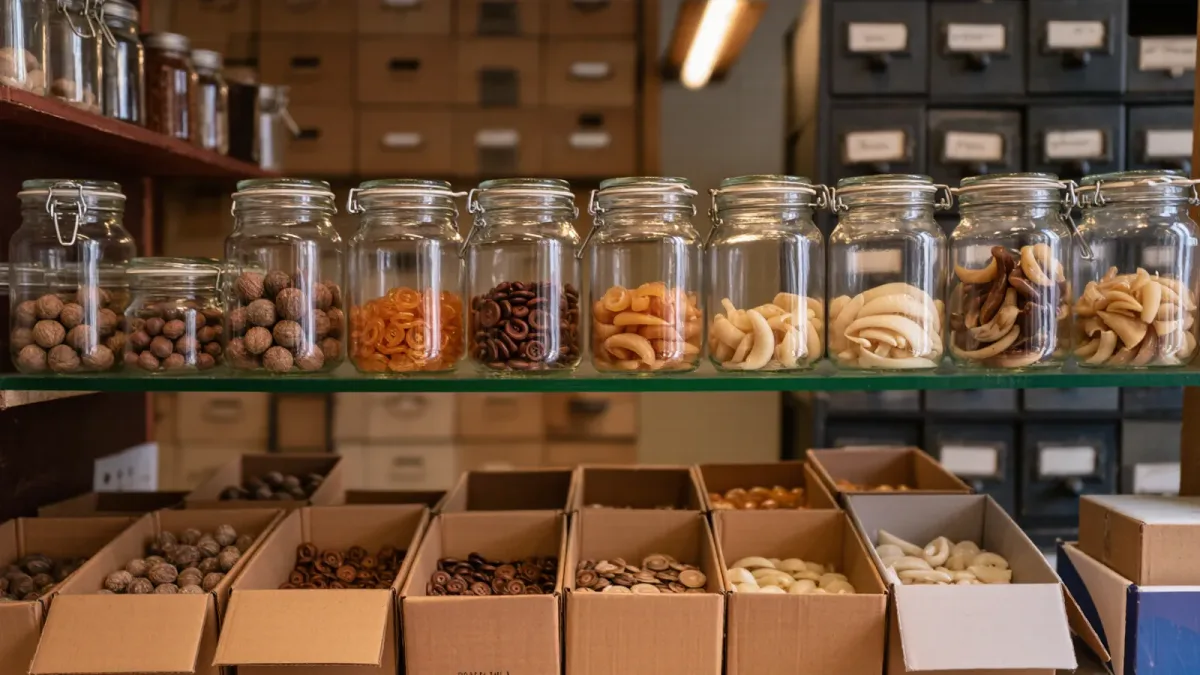
A button costs a garment factory anywhere from cents to several euros per unit, and a coat takes ten to fifteen of them — which is why trim selection is the fastest forensic read on a garment's budget. Corozo, cut from the tagua palm nut, and natural horn sit at the premium end; dyed plastics and thin zamac alloys fill the value tiers. Learn the materials and you can price a coat's construction within seconds, no label required.
This matters because closures are also the parts you touch daily. A garment can hide a cheap lining, but it cannot hide a button that cracks in six months.
The materials, ranked by what they do
Corozo — sometimes sold as "vegetable ivory" — is a hard natural nut that takes dye deeply and holds carved detail; it scratches rather than shatters and is a byproduct of the tagua palm, which makes it a favorite of brands trading on natural materials. Horn, typically from cattle as a byproduct, shows layered translucence: hold it to light and you see striations no plastic convincingly copies. Mother-of-pearl reads by iridescence and a cool touch. Polyester buttons mimic all three, but feel warm in the hand and show mold seams — run a finger around the edge. Metal closures split by alloy: solid brass ages with patina, while plated zamac wears through to white metal at the high points.
- Sew-through vs shank: a shank button with a wrapped thread neck sits better on heavy coats and is a tailoring signal.
- Reinforcement: on quality outerwear, buttons sit through doubled interfacing or a hidden patch — a loose button on new wax cotton means the foundation was skipped.
- Spare buttons sewn inside the hem are a cost of cents that signals the factory expected the garment to be kept.
Related stories: Inside House Archives: Where a New Collection Actually Begins · The Tailored Shoulder: Hair Canvas, Pad Stitching and a Jacket's Spine.
Why spring coats are the tell
Trench and raincoat season is button season: these garments lean on closures structurally, not decoratively. On a proper trench, the horn or corozo buttons anchor through a storm fly with reinforced stitching, and the belt buckles in leather-covered metal. On a value-engineered version, the same silhouette carries hollow plastic and a coated wire buckle — the design copy survives, the service life does not.
How to audit a garment in ninety seconds
Flick a button with a fingernail — natural materials sound dull and dense, hollow plastic clicks. Check the back for mold lines and brand engraving (engraving costs a die, so its presence is a budget statement). Tug the shank threads. Then open the spare-button pouch: cut thread ends sewn neatly tell you someone downstream cared. A coat that passes these checks is worth its rack price far more often than the label suggests.
Where buttons are made, and why it matters
Button production clusters in a few towns — Italy's Marche region and England's Birmingham jewelry quarter among them — where families have cut nut, horn and pearl for generations. The geography is a quality signal: workshops there stock blanks in graduated sizes and can engrave, dye and finish in-house, which is why designer houses can specify a custom corozo in their exact shade with a logo die. Mass-market buttons, by contrast, are catalog items ordered by code from injection molders, which is why the same four-holed black disc turns up across half the high street. For a buyer, the practical shortcut is the spare-button pouch and the label: a named button town, a die-engraved back, or a matching thread wrap all indicate a brand that ordered buttons as components rather than picked them from a catalog. Cost difference per garment is small — a few euros at most — which is why their absence on an expensive coat is more damning than their presence is praiseworthy on a cheap one.
The takeaway
Trim is the honest invoice of a garment. Corozo and horn do not make a coat good — but cheap buttons reliably announce everything else the maker cut.