A luxury SUV is worth its sticker price when the premium sits in things you can touch, hear and keep: the hide on the seat, the seals on the doors, the suspension that reads the road before you do. It is not worth the price when the money has gone into chrome, screens and a nameplate. The difference is findable in about twenty minutes of close looking, and it does not require a mechanic.
The honest qualification is this: no badge guarantees either outcome. Two vehicles at the same price can spend that money in entirely different places. What follows is a map of where a well-spent premium actually goes, so the question shifts from how much to what for.
Where does the money actually go first — the cabin or underneath it?
Start with the cabin, because it is where cheap construction hides least well. Run a hand along the top of the door card where your forearm rests. In a properly finished interior, that surface is stitched leather, real wood or a soft-touch composite with a tight, even grain. In a cost-cut one, it is hard plastic with a leather-look embossing, and the seam where two materials meet will show a visible gap or a glue line.
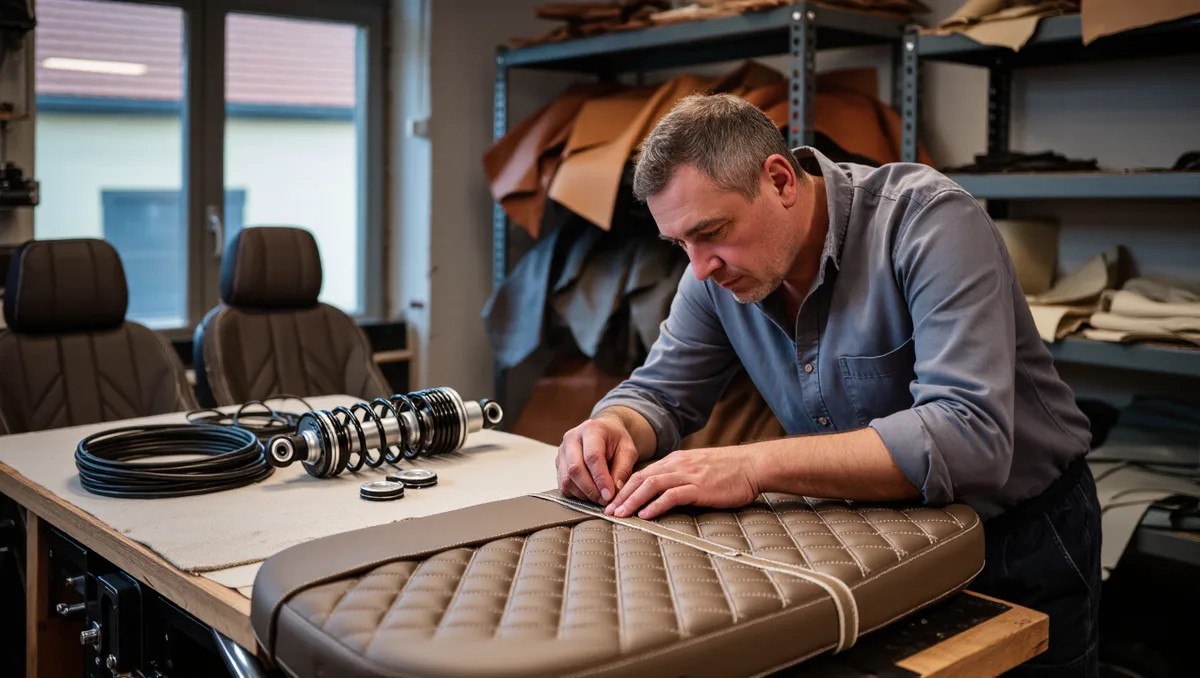
The seats tell the same story. Full-grain and top-grain hides take dye unevenly and show natural variation; corrected grain, heavily pigmented and embossed, looks uniform and ages poorly. The same logic that separates a good jacket from a bad one applies here — our guide to saddle stitching and leather grades explains why seam construction, not the word "leather" on the spec sheet, decides how a surface holds up. In a car, check whether the stitching runs through the material or the trim pieces are simply glued on. Glue fails first. We covered a connected angle in Saddle Stitching: The Hand Seam That Decides Whether a Bag Lasts Decades.
Smell is a data point too, and not the flattering one people assume. A heavy synthetic fragrance in a new cabin often masks off-gassing from adhesives and lower-grade foam. A quiet, neutral cabin smell usually means better materials doing less work.
What does air suspension actually do, and is it worth having?
Air suspension replaces conventional steel springs with pressurized rubber bellows, fed by a compressor. The system can hold the ride height constant regardless of load, soften over sharp impacts and, in many setups, firm up at speed or lower itself for efficiency. The practical effect is a vehicle that feels smaller than it is — a large SUV that does not pitch and wallow over undulating roads.
Worth having? For a heavy, tall vehicle driven daily on mixed roads, most buyers who have lived with it do not want to go back. The honest counterweight is maintenance: air springs and compressors are wear items, and their replacement costs real money once the warranty ends. The value case rests on how long you keep the vehicle. A decade of comfort justifies the system; a three-year flip does not, which is why it matters in resale discussions too. Our guide to choosing a luxury car brand without overpaying for the badge covers how option choices move used values. For related coverage, see How to Choose a Luxury Car Brand Without Overpaying for the Badge.
Why does sound deadening separate the serious from the superficial?
Close the door of a well-engineered SUV and you hear one thing: a dull, heavy thud. That sound comes from mass — thicker glass, layered door seals, insulation mats under the floor and inside the wheel arches. None of it is visible, all of it is expensive to ship and fit, and it is one of the first line items a cost-reduction exercise cuts.
The test is not the closed door but the open road. Wind noise around the mirrors and A-pillars, and the low-frequency drone from the tires, are where thin sound insulation announces itself. A quiet cabin at motorway speed is one of the most honest signals that the maker spent the money where it cannot be photographed.
How do you tell a real premium from a badge premium?
Our analysis is that the badge premium is real but smaller than it looks, and it is testable in person. The checks below take less time than a test-drive paperwork session.
- Panel gaps. Run a finger along the shut lines between doors, bonnet and tailgate. Even, consistent gaps indicate disciplined assembly; wavering ones indicate tolerance stacking.
- Switchgear. Flick the indicator stalk, turn the climate knob. A damped, weighted action costs pennies more per unit and signals the supplier tier. Hollow, rattly plastics on frequently touched controls say the opposite.
- Underneath. If you can crouch and look at the underbody, look for exposed, uncoated components and visible wiring runs. Engineering effort shows even where marketing never points the camera.
- The rear seat. Makers spend on the front row because reviewers sit there. The rear seats, the second-row materials and the third-row mechanism reveal how evenly the budget was distributed.
None of these checks requires expertise. They require a willingness to be unglamorous in a showroom.
What this means for the price-per-wear question
The house question applies to cars as much as to coats: how is it made, how long will it last, what does it cost per use? A luxury SUV is a high-mileage, long-ownership object, so the calculation favors durable materials and serviceable mechanicals over visual drama. The leather that ages rather than cracks, the suspension that can be rebuilt rather than replaced, the cabin that stays quiet at year eight — these are the line items that repay the sticker.
What remains unknown, and cannot be settled in a showroom, is each specific vehicle's long-term reliability record. That varies by model year and powertrain in ways no general explainer can resolve. The durable advice is to separate the two judgments: judge the build quality with your hands on the day you buy, and judge the ownership risk with model-specific service history before you commit. The badge answers neither question by itself.
Sources: grammarden.blog · correctwording.com · dictionary.com