A floor that photographs like oak, installs in an afternoon and shrugs off a spilled glass of wine has an obvious appeal. Luxury vinyl plank flooring — LVP, in the shorthand every contractor now uses — became the default of ambitious renovations because it answers three questions at once: how it looks, how long it lasts and what it costs to live with. The qualification sits in the first word of its name, which is a marketing claim rather than a description of the material.
The word "luxury" normally signals rarity, handwork and price. As Cambridge Dictionary usage shows, "why" is the question of reason and purpose — and the purpose of that adjective here is reassurance, not description. The planks are printed and layered synthetics. Nothing about them is rare. What they offer instead is a convincing surface and a forgiving structure, and for many renovations that trade has proved irresistible.
This is a design story as much as a materials story. LVP rose alongside the open-plan renovation and the photographic interior: rooms that needed to look finished immediately, survive real life and not demand maintenance. The material fits that brief almost perfectly. Whether it fits a house meant to last decades is a separate question, and the honest answer depends on which layer of the plank you are standing on. Readers following this should also see Saddle Stitching: The Hand Seam That Decides Whether a Bag Lasts Decades.
What is actually in a luxury vinyl plank?
Strip the photograph away and an LVP is a sandwich. The bottom is a backing layer, often padded for sound. Above it sits a rigid or flexible core — the layer that gives modern planks their stability and their click-together edges. Then comes the printed film: a high-resolution photograph of wood, stone or anything else the catalogue wants. The top is a clear wear layer, a transparent sheet whose thickness is the closest thing the category has to a quality measure.
That structure explains both the appeal and the limits. Because the wood is a picture, the plank never cups, never dries out and never needs finishing — there is no wood to move. Because the wood is a picture, it also cannot be sanded back or refinished. A scratched solid-oak board can be renewed; a scratched LVP plank is replaced. The material is honest about this if you read the spec, and silent about it if you read only the marketing.
Why did it displace hardwood in so many renovations?
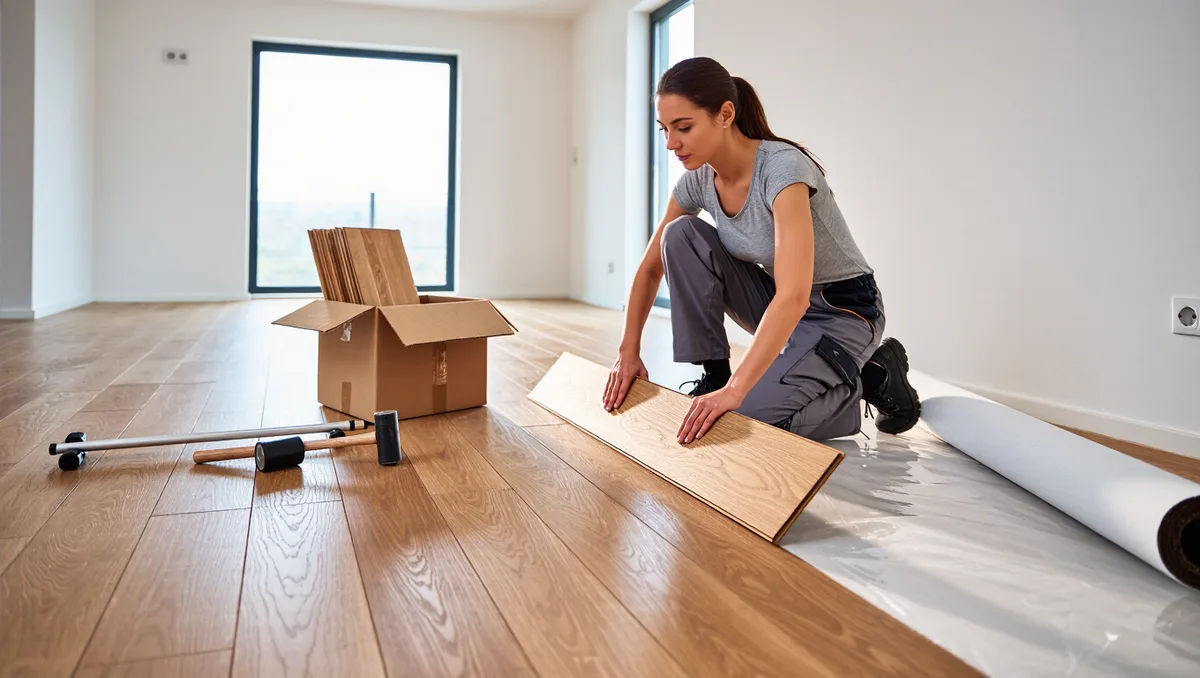
Three forces converged. The first is cost: printed wood is dramatically cheaper than milled wood, both in material and in the labor to install it, which is a fraction of a hardwood floor's. The second is speed. Click-together planks float over most existing floors, so a renovation that once meant weeks of sanding, staining and curing now means a weekend. The third is lifestyle: LVP is water-resistant where hardwood is famously not, which made it the safe recommendation for kitchens, basements, rentals and households with dogs.
There is also a taste effect. The wide-plank, lightly finished oak look that dominates interiors photography is exactly what LVP printers reproduce best. The material did not just serve the trend; it flattened the cost of joining it. A floor that once separated houses by budget now photographs nearly identically across them — which is, depending on your view, either democratization or the erasure of one of the few places a home showed its quality.
How the word "luxury" migrated from ateliers to flooring aisles
It is worth pausing on the naming, because Above Magazine's usual beat is the kind of luxury where the word still means something — a hand seam, a tannage, a movement finished over months. As our guides to the hand seam that decides whether a bag lasts decades and the leather grades that decide what a jacket is worth argue, real luxury is verifiable in the construction. In flooring, "luxury" was borrowed precisely because the construction cannot be verified at a glance: the word substitutes for the evidence. We covered a connected angle in Full-Grain, Top-Grain, Bonded: The Leather Grades That Decide What Your Jacket Is Worth.
The dictionary sense supports the point. Usdictionary defines "why" as the word for reason and purpose — and the purpose of the prefix is to make a commodity read as a premium. A more useful vocabulary for a buyer is the one the industry itself uses internally: wear-layer thickness, core rigidity, print registration. Those terms describe the product. "Luxury" describes the ambition of the marketing department.
What should a buyer actually check before choosing it?
Our analysis is that LVP is a rational choice in specific rooms and a compromised one as a whole-house default. If you are considering it, the checks are straightforward and none require expertise:
- The wear layer. This clear top sheet is what stands between the photograph and your furniture. Thicker generally means longer life; a manufacturer's warranty class usually reflects it. Ask for the number, not the adjective.
- The core. Rigid cores resist denting under heavy furniture; flexible ones feel softer underfoot but telegraph every imperfection in the subfloor.
- The print quality. Look at the plank end to end. Cheap printing repeats its pattern visibly; better printing varies the grain so no two planks read as twins.
- Repairability. Ask how a damaged plank in the middle of a room is replaced. If the answer involves dismantling the floor, factor that into the real cost.
- End of life. Vinyl is not readily recycled in most municipal systems. A floor chosen for a decade of convenience becomes a disposal question later.
None of this makes LVP a bad product. It makes it a specific one: a surface material, excellent at looking finished and resisting water, with a fixed lifespan and no second act. Hardwood, by contrast, is slow, expensive and renewable. The right question is not which floor is better but which failure mode you would rather live with — a floor that wears and can be renewed, or one that stays uniform until it is replaced whole.
What this means for a buy-less household
For readers who buy less and choose better, the LVP story is a familiar one in a new room. The category succeeded by compressing a craft good into a consumer good: the look without the material, the lifespan without the repair path. That compression is genuinely useful where life is hard on floors — a rental, a basement, a kitchen that hosts everything. It is a poor substitute where the floor is meant to outlive the renovation that installed it.
The evidence here is structural rather than statistical, and it points one way: read the layers, not the label. A floor is the largest surface in a home and the one you touch most. Whether it carries a photograph of oak or the oak itself is a decision about time — how long you intend to stay, and what you want the house to be able to do when you are done with it.