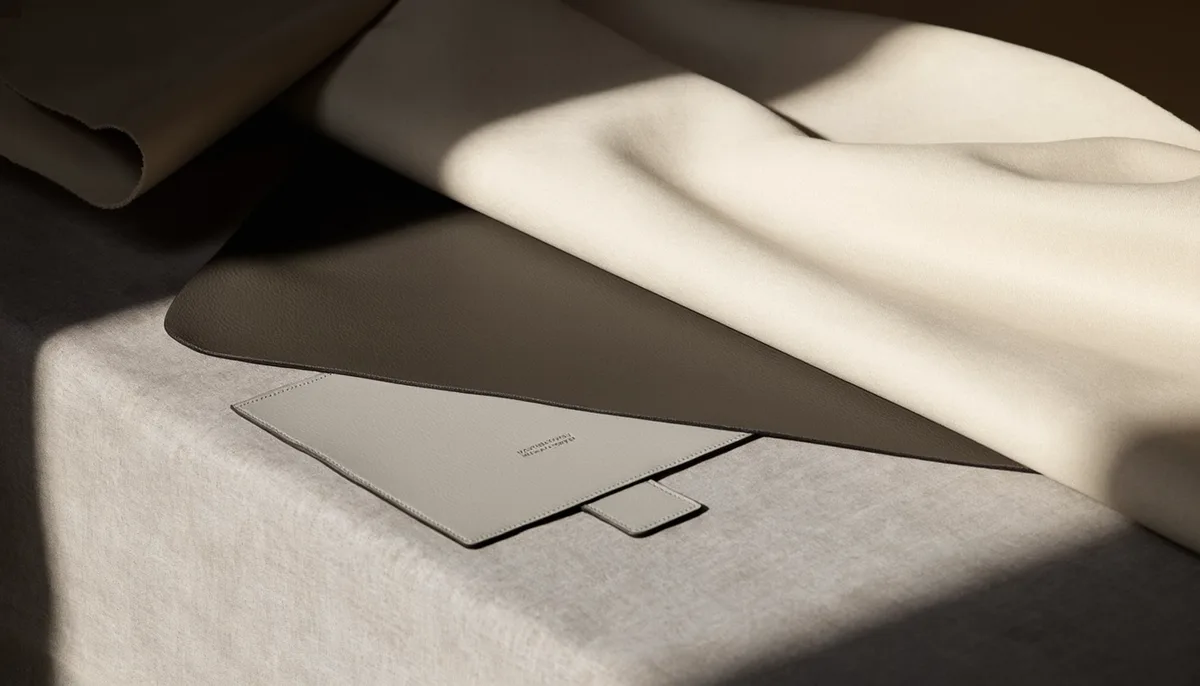
Deadstock fabric is unused textile that already exists — leftover from a cancelled order, a production overrun, or a season a brand never finished selling through. Luxury houses now buy it instead of commissioning new cloth, because the material is often high grade and the volume is fixed, which suits a small, considered run. The trade-off is real: brands gain a lower-impact material story, but lose the ability to reorder the exact same fabric twice.
That scarcity is the whole point, and also the whole problem. A designer building a collection around deadstock is not choosing a fabric and then deciding how much to buy. They are finding a fixed lot — sometimes a single roll — and designing around whatever quantity survived. There is no going back to the mill for more of that colorway once it sells through. For related coverage, see Take-Back Programs at Luxury Houses: Circularity or Destruction with Better PR?.
This piece looks at where deadstock actually comes from, why it has moved from a bargain-bin term to something closer to a selling point in luxury fashion, and where the sustainability claim holds up versus where it needs a harder look. We covered a connected angle in Secondhand Luxury Is Sustainability's Only Growing Market — With an Asterisk.
Where Does Deadstock Fabric Actually Come From?
Most deadstock falls into two categories: mill surplus and designer surplus. Mill surplus happens when a factory produces more than an order needs, a customer cancels mid-run, or a batch comes out with a minor flaw that has nothing to do with the fabric's quality — a shade slightly off-spec, a print alignment issue, that sort of thing. According to Fabric Sight, mills often produce a small cushion above the ordered quantity to cover errors during production, and that cushion is frequently what ends up as deadstock once the original order ships complete.
Designer deadstock is different. It is fabric that made it all the way to a fashion house — often a luxury one — and then never became a garment. A collection gets trimmed at the last minute, a design gets cut from the line, or a season simply doesn't sell through and the brand moves on before using every metre it bought. Because this fabric was commissioned for high-end production in the first place, the quality is typically what you'd expect from a luxury supply chain, not a factory reject bin.
It's worth separating deadstock clearly from recycled fabric, since the two get lumped together constantly. Deadstock is virgin material that was simply never used. Recycled fabric has been broken down — old garments, scraps, sometimes plastic bottles — and reprocessed into new yarn or cloth. One skips manufacturing entirely by using something that already exists; the other reprocesses something that already served a purpose. Readers who want the fuller mechanics of reprocessing can see how that differs in how fiber-to-fiber recycling actually works.
Why Are Luxury Brands Building Collections Around It?
The appeal for a luxury house is less about cost-cutting and more about story and scarcity working together. A dress cut from a single deadstock roll cannot be reordered in that exact fabric once it sells out, which gives a brand a genuinely limited edition without inventing artificial scarcity.
There's also a quality argument that runs against the usual assumption that sustainable materials mean compromise. Because so much designer deadstock originated as premium mill output in the first place, the hand-feel and construction quality can match or exceed what a brand would get through a standard reorder. And because the fabric already exists, brands sidestep the water, energy and chemical footprint of producing new textile from scratch — one of the more direct ways a label can lower its material impact without changing a single design.
None of this is free of friction. Buying deadstock usually means buying a fixed, unrepeatable quantity, so a brand has to plan pattern layouts and sizing runs around exactly how much fabric survived — not how much the design ideally calls for. That constraint shapes the collection as much as any aesthetic decision does.
What Does the Economics Actually Look Like?
Deadstock is generally cheaper than commissioning equivalent fabric new, since the mill or brand selling it has already absorbed the original production cost and simply wants to recover value from stock that would otherwise sit in a warehouse. There's typically no minimum order quantity either, since the seller only has a finite amount on hand regardless of who's buying — a detail that matters more to smaller labels than to the majors, who buy deadstock in the context of an entire collection strategy rather than out of financial necessity.
| Factor | Deadstock Fabric | Virgin Fabric Order |
|---|---|---|
| Reorder possible | Rarely — quantity is fixed | Yes, to spec |
| Minimum order | Usually none | Often required |
| Relative cost | Typically lower | Higher, reflects full production |
| Consistency across a run | Limited by available lot | Controlled to order |
| New-production footprint | Avoided | Incurred |
The market for this material has grown alongside demand for lower-impact sourcing, though the scale of that growth is best treated as directional rather than precise, since third-party market-sizing figures for a category this fragmented vary by methodology.
Where Does the Sustainability Claim Hold Up — and Where Doesn't It?
The core environmental logic is straightforward: using fabric that already exists means skipping the water, energy and raw-material draw of producing new cloth. That's a real avoided impact, not a marketing flourish, provided the fabric genuinely would have gone unused otherwise.
But deadstock isn't a fix for the industry's underlying overproduction problem — it's a way of extracting some value from that overproduction after the fact. The textile industry generates enormous volumes of waste every year, and deadstock sourcing addresses only the portion of that waste that happens to already be sitting in a warehouse in usable form, rather than the volume being produced in excess in the first place. A brand that leans on deadstock while still overordering new virgin fabric elsewhere in its supply chain hasn't solved anything; it has simply found a second material story to tell alongside the first.
There's also a traceability gap worth naming plainly. Deadstock's origin story — whose overrun it was, what mill made it, whether that mill held any credible certification — is often thin or unverifiable once the fabric changes hands more than once. A brand can honestly say the material avoided new production. It usually cannot tell you much more than that about where the fabric actually came from. Readers checking a brand's broader eco-language against what's actually documented may find it useful to run the claim through a quick greenwashing check before taking a deadstock story at face value.
What This Means for a Considered Wardrobe
A deadstock piece can be a genuinely good buy: often better fabric than the price would normally get you, and functionally unrepeatable once it's gone. That uniqueness is worth something if longevity, not trend-chasing, is the goal.
What it isn't is a guarantee of a fully accountable supply chain. Ask what's actually being claimed — avoided new production, yes; verified mill practices further back, not necessarily. The honest version of the deadstock story is narrower than the marketing version, and it's still worth telling.
Weighed against a full cost-per-wear calculation, a well-made deadstock piece that will be worn for years earns its place regardless of how the fabric started out. The material story is one input, not the whole verdict.