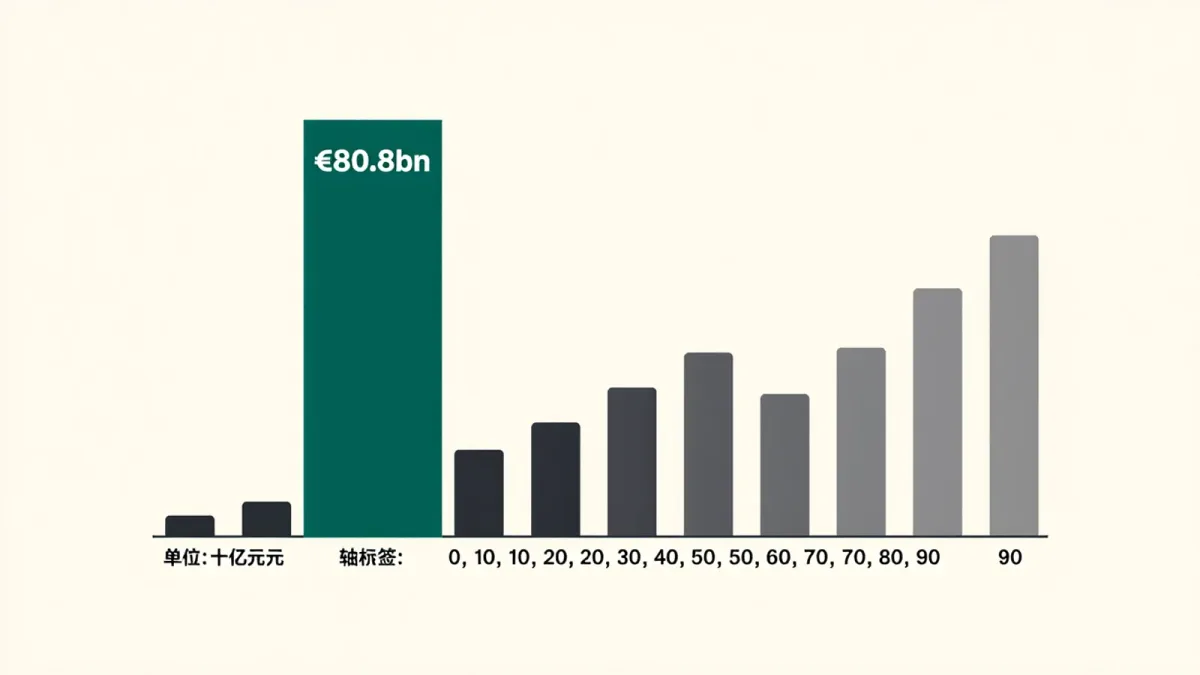
LVMH reported full-year 2025 revenue of €80.8 billion on January 27, 2026 — a decline of roughly 5 percent year-on-year, but slightly ahead of the analyst consensus near €80.6 billion compiled by Visible Alpha, per S&P Global Market Intelligence. The group's own headline called it "solid performance in a disrupted global economic and geopolitical environment."
For a sector that spent 2025 fighting simultaneous slowdowns in China and the aspirational customer, the beat matters less than the composition. A roughly €80 billion base still dwarfs every competitor — Kering, Hermès and the listed specialists each operate at a fraction of that scale — so even a shrinking LVMH sets the industry's pricing and marketing weather.
Why the miss-and-beat framing misses the point
A 5 percent reported decline at this scale translates to billions of euros of demand simply absent from the market, much of it concentrated in Fashion & Leather Goods — the division that houses Louis Vuitton and Dior and that funds the group's store expansions and fashion-week spectacle. S&P Global's post-earnings note flagged a "cloudier" 2026 outlook even while crediting the beat, which is the honest summary: stabilization, not recovery.
Related stories: Hermès Posts €8.2 Billion for the Half — Growth Other Houses Envy · Matthieu Blazy's Chanel Couture Debut: Lightness as a Strategy.
What it means for the shop floor
Two consequences reach actual customers. First, pricing discipline: with volumes soft, houses lean on fewer, better products rather than blanket increases — expect more emphasis on icons and fewer experimental SKUs. Second, the creative reset LVMH executed across 2025 — new designers installed at its biggest houses — now has to sell, and the 2026 collections are effectively the first full test of whether design change can do what price increases did in 2021-2023.
The divisional detail sharpened the picture: Fashion & Leather Goods — the engine that houses Louis Vuitton and Dior — bore the brunt of the decline, while the selective retailing arm held better than the conglomerate average. Analysts parsing the call flagged the aspirational customer pullback in the United States and a slower-than-hoped Chinese recovery as the twin drags, alongside currency headwinds that the group flagged as a factor entering 2026.
The takeaway
Read the January 27 release less as a scoreboard than as a budget: the divisions LVMH defends hardest in 2026 — leather goods, watches, its American and Japanese client bases — are where service, craftsmanship and resale value are most likely to improve. Groups pour attention where the money is; €80.8 billion shows exactly where that is.